2026: Why West Bengal May Decide India’s Political Future
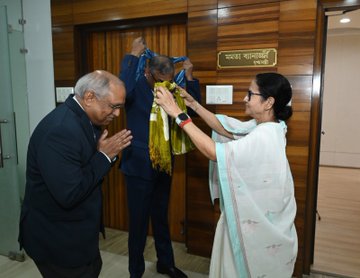
West Bengal CM Mamata Banerjee meets Tata Sons Chairman Natarajan Chandrasekaran! (Image AITMC, X)
As BJP shifts from personality attacks to demographics, infiltration, and governance, West Bengal’s 2026 election is emerging as a national inflection point with consequences far beyond the state.
By NIRENDRA DEV
New Delhi, January 1, 2026 — Wheels are turning within wheels in Indian politics—and 2026 may well emerge as the ‘Year of the West Bengal polls.’ What is unfolding in the state is no longer being projected as a routine electoral contest, but as a high-stakes ideological and demographic confrontation with national implications.
“This is not just a political battle for us,” B L Santhosh, BJP General Secretary (Organisation), has declared. “It is a civilisational battle. To save India, we have to win Bengal.”
Santhosh has repeatedly underlined what the BJP describes as a “serious demographic challenge” in West Bengal, arguing that prolonged Muslim appeasement politics has altered the state’s political and social dynamics. For the party, Bengal has become a test case—one that will draw nationwide attention and even international scrutiny.
The concerns extend beyond rhetoric. West Bengal carries a long history of poll-related violence, raising persistent questions over whether genuine voters will be able to freely exercise their franchise. Equally pressing is whether the electoral process itself can unfold peacefully.
At the heart of the immediate political tension lies the Special Intensive Revision (SIR) of electoral rolls. Leader of the Opposition Suvendu Adhikari has warned that if SIR is not carried out “properly and to the satisfaction of the Election Commission,” the BJP will ensure that elections are not conducted at all.
The implication is stark: failure to hold elections by March–April 2026, at the end of the Assembly’s five-year term, would constitutionally necessitate President’s Rule—effectively ending Mamata Banerjee’s tenure.
Sensing the scale of the battle, BJP’s chief poll strategist Amit Shah has already begun extensive tours of the state. At a media interaction on December 30, the Union Home Minister made clear that illegal infiltration would dominate the BJP’s campaign.
“If we come to power in West Bengal in 2026, our first task will not only be to stop illegal infiltration but to drive out illegal infiltrators currently residing in the state,” Shah said.
He also questioned why West Bengal alone resists barbed fencing along the Bangladesh border, arguing that infiltration has become “not just a state problem, but a national one.”
Notably, the BJP has abandoned direct personal attacks on Mamata Banerjee this time—learning from 2021, when slogans like “Didi, Oh Didi” appeared to backfire and consolidate Trinamool Congress support.
Instead, the BJP’s 2026 focus is sharply defined: illegal infiltration, jobs, industrialisation, infrastructure, corruption, and women’s safety.
Ironically, it is Mamata Banerjee who has now resorted to personal barbs—likening Amit Shah to Dushashan from the Mahabharata and Prime Minister Narendra Modi to Shakuni. Shah has countered this shift by questioning the timing of her newly discovered temple politics, suggesting it has come “far too late in the day.”
The Home Minister has also trained his guns on corruption—from chit fund scams and school-job scandals to coal and cattle smuggling—noting that several senior TMC leaders are already behind bars.
On women’s safety, Shah struck a particularly raw nerve: “From R.G. Kar Medical College to South Kolkata Law College and Sandeshkhali, women in West Bengal are not safe anywhere. Mamata Banerjee owes the people an explanation.”
For the BJP, Bengal also carries symbolic weight. Party founder Shyama Prasad Mukherjee hailed from the state—making a Bengal victory not just electoral, but ideological redemption.
Meanwhile, a new political churn appears underway within the Muslim electorate itself. For the first time in years, it no longer looks monolithic. Suspended TMC MLA Humayun Kabir’s launch of the Janata Unnayan Party—and his controversial foundation-laying for a Babri Masjid in Murshidabad—signals internal fragmentation that could upend existing vote banks.
Strikingly, Shah has kept a deliberate distance from temple–mosque polarisation, calling it a TMC problem and refusing to let the BJP’s core campaign themes be diluted.
On the economic front, Shah cited what he called Bengal’s dramatic decline. Once, when India’s per capita income stood at ₹100, Bengal’s was ₹127. Today, he claimed, it has fallen to ₹73 against a national ₹100, pushing the state below the national average.
Whether these claims withstand statistical scrutiny or not, the political message is unmistakable: Bengal has fallen behind—and 2026 is being framed as its last chance for course correction.
(This is an opinion piece. Views expressed are author’s own)
Follow The Raisina Hills on WhatsApp, Instagram, YouTube, Facebook, and LinkedIn




About The Author



Most journalists have failed to highlight ,deliberately or otherwise, the rigging of electoral rolls with their own cadres by the Left Front in Bengal & a majority of these erstwhile cadres having shifted in 2011 to TMC & also a good number of them to the BJP post 2016
SIR everywhere raises grave questions with regard to the electoral process even before a single vote is cast & more so in Bengal which is yet to slake the Sangh Brigade’s unseemly lust for political power at any cost & which will play out before elections in various ways & during elections on the streets of Bengal
Shah’s recent rantings in Bengal about the state of economy of Bengal compliments the administrations run by various Congress governments & most journalists have maintained a deliberate silence on the compliments paid to the Congress party governments by Shah