


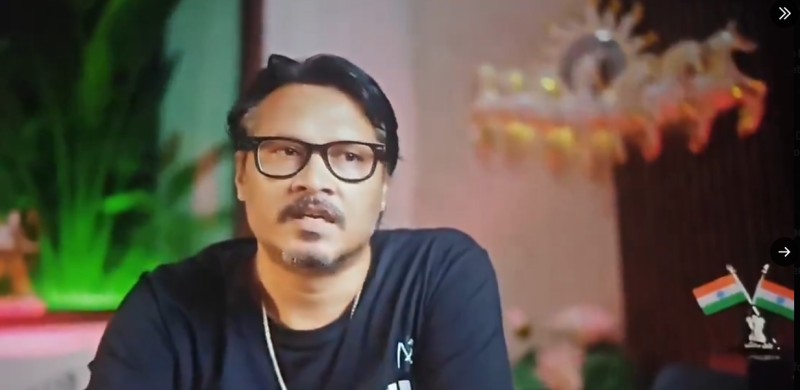
By AMIT KUMAR
A week ago, Ajeet Bharti was one voice among many pushing for reservation reform. After an FIR under the SC/ST Act, he’s become a national flashpoint — with prominent voices across India’s right and legal commentary sphere rallying behind him.
New Delhi, August 25, 2026 — Ajeet Bharti built his career, over more than a decade, as an independent commentator operating outside India’s mainstream newsrooms. This month, a single video and the legal case it triggered turned him into something bigger: the central, most visible face of a reservation-reform movement that has been building for weeks, and a flashpoint in one of India’s oldest and most sensitive political fault lines — the debate over caste-based quotas.
Slapped with SC/ST Act provisions purportedly on complain of Nagina Lok Sabha MP Chandrashekhar Azad Ravan, Bharti has become the face of a revival of debate around the prevention of atrocities against scheduled castes and scheduled tribes. Patanjali founder Baba Ramdev has also jumped in the debate.
“If abusing SC/ST is a crime, then it also should be a crime to abuse a Brahmin,” Ramdev told reporters. He added that “it’s now fashionable to abuse even saints now.”
Bharti in a livestream took up a remark from his audience that asked him to wed his sister to the Nagina Lok Sabha MP. To that he answered arguably in a most rustic and provocative way, apparently taking an offence. Bharti stated that he speaks that way only — no holds barred.
From Newsrooms to Independent Media
Born in Bihar in 1987, Bharti studied at Sainik School Tilaiya before earning a BA in English Literature from Delhi University’s Kirori Mal College and a master’s in mass communication from Guru Gobind Singh Indraprastha University. His early career followed a fairly conventional media path: stints at The Times of India, The Economic Times, and IANS, followed by a period as a senior editor at ByteDance.
He later became the founding editor of OpIndia’s Hindi edition, before co-founding the YouTube-based outlet “DO Politics” and eventually launching his own venture, AB4K Media, where he now produces political commentary, satire, and analysis aimed primarily at a right-leaning, “Indic” audience.
Over the years, Bharti has built a reputation for combative, unapologetic commentary — willing, as his own website puts it, to question “any institution, be it government, judiciary or media itself.” That reputation, and the large following it built him on YouTube and X, positioned him as a natural rallying figure once he began speaking out on reservation policy.
The Reservation Hatao Andolan
Bharti emerged as a central figure at the “Reservation Hatao Andolan” (Remove Reservation Movement) gathering at Delhi’s Jantar Mantar on August 21. He used the platform to call for a government white paper reviewing nearly eight decades of India’s reservation system, a “quota within quota” mechanism to ensure benefits reach the most disadvantaged groups, expanded support for Economically Weaker Sections, and minimum qualifying marks for reserved-category candidates.
That mobilisation placed reservation reform back at the center of national conversation at a moment when the issue was already resurfacing — RSS chief Mohan Bhagwat has periodically suggested reservation beneficiaries voluntarily step aside for others, a comment that has drawn its own share of political controversy in recent months.
The FIR: What’s Actually Alleged
Two days after the Jantar Mantar gathering, on August 23, Delhi Police registered an FIR against Bharti at the North Avenue police station, based on a complaint filed by the Delhi unit president of the Azad Samaj Party (Kanshi Ram). According to reporting on the FIR’s contents, it stems from an August 22 video in which Bharti is alleged to have made objectionable remarks involving Nagina MP Chandrashekhar Azad — a Dalit leader historically also known by the alias “Ravan” — along with references to B.R. Ambedkar. The complaint alleges Bharti used caste-based and abusive language, made sexually degrading remarks concerning women, and issued threats.
The FIR invokes multiple provisions of the SC/ST (Prevention of Atrocities) Act, Section 67 of the IT Act, and Sections 196(1)(c) and 351(3) of the Bharatiya Nyaya Sanhita — provisions that broadly cover intentional insult or intimidation of SC/ST community members, promotion of hatred, and threats.
Bharti’s Account
Bharti has publicly defended his comments rather than retracting them. In a post on X, he said the remarks came in direct response to a comment he described as sexually degrading, allegedly directed at his mother or sister by another user, who reportedly suggested — using language he characterized as carrying a “rapist mentality” — that his sister be married off to Azad. Bharti wrote that he could not have stayed silent in the face of that comment: “If someone… directly says about my mother or sister that he will get her married to Chandrashekhar, and I remain silent, then tell me what kind of son or brother I would be?”
He maintained he did not use caste-based slurs against Azad in his response, telling reporters he understood his own limits and had spoken deliberately. Bharti also said the FIR was registered just after midnight at the North Avenue station, argued that none of the sections cited would hold up in court, and claimed the large majority of such cases are filed primarily to harass the accused rather than to secure convictions.
Separately, some commentary sympathetic to Bharti — including an opinion piece published by OpIndia — has argued that, based on the video and complaint as circulated, Bharti’s comments referenced the family members of the original commenter rather than Azad’s own family, and that no rape threat was directed at Azad or his relatives, contrary to some claims that circulated on social media.
In that video, Bharti after launching a tirade against Bharti, saying that “he will rather spit on the face of Ravan”, goes on to give a historical context on Ambedkar’s legacy. “Ambedkar was supported in his education by a Rajput and a Brahmin. He gathered degrees. There was no reservation then,” said Bharti in his livestream show.
He argued that he didn’t insult Ambedkar by speaking against reservation.
None of these competing accounts have yet been tested in court, and police have said they are reviewing the full video and its context before proceeding further.
The Wave of Public Support
The FIR quickly became a rallying point well beyond Bharti’s existing audience, drawing statements from a range of prominent commentators, lawyers, and public figures.
Yoga guru Baba Ramdev weighed in with a broader constitutional argument, saying: “if insulting SC/ST communities violates the Constitution, insulting Brahmins should be treated the same way under it.”
Author and commentator Anand Ranganathan criticized the specific legal provisions invoked, calling the SC/ST Act sections and BNS clauses used against Bharti “draconian,” and noting they carry potential jail terms of up to five years.
The right-wing advocacy group The Jaipur Dialogue similarly labelled the case an example of the SC/ST Act being “misused” and called for legal amendments. Lawyer J. Sai Deepak went further, arguing the moment called for judicial review of 2018 amendments to the SC/ST Atrocities Act — amendments that reversed earlier Supreme Court-imposed safeguards intended to prevent misuse of the law, which he argued had made the situation worse rather than better.
Political commentator Tehseen Poonawalla framed his support in more overtly political terms, alleging — without providing independent verification — a pattern of selective enforcement in which certain protest groups faced no charges for violence against Delhi Police while Bharti was booked despite what Poonawalla characterized as more restrained conduct. He connected this to the earlier Jantar Mantar mobilisation, urging supporters not to let Bharti be “bullied,” regardless of whether they personally agreed with him.
A Contested, Unresolved Case
It’s worth being precise about what remains genuinely unsettled here. The FIR represents one party’s allegations, formally registered by police but not yet examined by any court. Bharti’s account represents his own defence and characterization of events. Some sympathetic commentary offers a third reading of the underlying video. None of these versions has been independently adjudicated, and police have indicated the investigation — including a full review of the video in question — is ongoing.
What is not in dispute is the case’s timing and its political resonance: it arrived just two days after Bharti helped lead one of the more visible reservation-reform demonstrations in recent memory, at a moment when reservation policy was already generating unusually heated national debate.
Reservation Policy Has Become “Dynastic,” Says Political Analyst, Calling for Overdue Review
Follow The Raisina Hills on WhatsApp, Instagram, YouTube, Facebook, and LinkedIn




