


By TRH World Desk
EAM S. Jaishankar spoke to Marco Rubio on killings of three Indians in American strikes in Gulf of Oman, which is seen too late, while PM Modi is yet to make a statement.
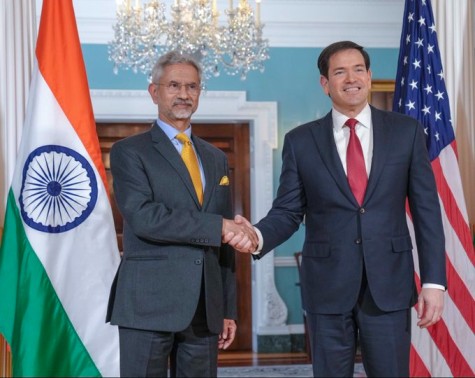
New Delhi, June 13, 2026 — Two days after the reports broke out of three Indian sailors dying in American attacks in Gulf of Oman, External Affairs Minister Subrahmanyam Jaishankar has spoken to his US counterpart Marco Rubio. Prime Minister Narendra Modi is yet to make a statement on the issue that is agitating the commentators, who are venting out their anger on the internet.
The American media has called the incidents “collateral damages.” The US Navy had fired missiles on commercial ships manned by Indian seafarers. That was part of the American blockade to coerce Iran for a “deal.”
Jaishankar has done what diplomats do: he picked up the phone. He spoke to Rubio and, in his words, “reiterated India’s strong protest at the attacks by the US Navy in the Gulf.” He stated plainly that “such lethal actions against commercial shipping are not justified.”
It was measured. It was correct. It was also largely futile — because the US continues to impose unilateral blockade with no sanctions of the United Nations.
Former Foreign Secretary Kanwal Sibal captured the moment with precision. He welcomed that the issue was raised at Rubio’s level, noting the need “to convey the lasting damage to ties such actions cause.” But Sibal also pointed to something revealing: Rubio apparently did not echo Trump’s accusation that Iran had staged drone attacks on Indian ships.
Sibal in his post on X rightly called it odd that Trump should have made such an accusation while the professionals at CENTCOM — who are actually pulling the triggers — apparently never advanced that narrative. The distinction between presidential bluster and military command is widening. It matters.
The attacks on ships with Indian sailors are the latest friction point in the relationship between Washington and New Delhi, which has reached new lows during US President Donald Trump’s second term. Yet New Delhi has chosen a peculiar response to these new lows: silence from the top.
Prime Minister Modi has said nothing. The US attacks on vessels with Indian seafarers come at a time when Modi is likely to hold bilateral talks with Trump on the sidelines of the G7 summit. There lies the political calculation — and therein lies the problem.
Modi’s silence reads, rightly or wrongly, as a reluctance to embarrass Trump ahead of a photo opportunity in France. That is a trade-off that the families of Aditya Sharma and Shivanand Chaurasiya were never asked to approve.
Sibal noted that the US “could have found a way to express regret.” It hasn’t. CENTCOM has instead been clinical, publishing strike footage, citing blockade violations, and treating the deaths of Indian maritime workers as acceptable operational friction.
Sharma’s grandfather told the Press Trust of India: “We want to know the full truth of what happened. Our hearts are shattered.” That shattering is not a geopolitical abstraction. It is a policy consequence.
Three Indian sailors are dead. Their names — deck cadet Aditya Sharma, engine fitter Shivanand Chaurasiya, and chief engineer Patnala Suresh — are not yet household names in India. They should be. They were killed after US Navy strikes on commercial tankers in the Gulf of Oman, near the Strait of Hormuz, in just three days over the past week. And as their families grieve, New Delhi’s loudest response has been diplomatic whispers.
Fire Over Hormuz: US bombs and Iran’s blockade shake the world
Follow The Raisina Hills on WhatsApp, Instagram, YouTube, Facebook, and LinkedIn




