


By TRH World Desk
Tulsi Gabbard’s departure from the Trump administration appears tied not only to personal reasons but also to growing tensions over Iran policy, intelligence assessments, and ideological divisions inside Trump’s second-term coalition.
Washington, May 23, 2026 — The resignation letter is eloquent and personal — a devoted wife stepping back to support her husband Abraham Williams through a rare bone cancer diagnosis. That is real and should not be dismissed. But the timing and context tell a more complex tale. Reuters reported that the White House “forced” Gabbard to resign, a claim the administration quickly slapped down as “slanderous.” She is the fourth Cabinet official to depart during Trump’s second term — and the circumstances surrounding her exit fit a familiar pattern: a Cabinet member slowly ground down by ideological misalignment, marginalized, and then eased out.
The Iran Fault Line: Where It All Broke Down
The core tension was always Iran. Gabbard is a committed non-interventionist — it is the central thread of her entire political identity, from her years as a Democratic congresswoman, to her break with the party, to her endorsement of Trump in 2024. She backed Trump because she believed he was a peace candidate.
As Trump pursued striking Iran to cripple its nuclear capabilities last summer, Gabbard released an unusual video warning about “warmongers carelessly fomenting fear and tensions between nuclear powers.” The video incensed Trump per a report by CNBC.
Trump did not forget it. Asked later that month about Gabbard’s prior Senate testimony that Iran wasn’t trying to build a nuclear bomb, Trump replied, as quoted by CNBC in its report, “I don’t care what she said,” and later added, “She’s wrong.” For a president who demands loyalty above all else, that public rebuke was a significant signal.
When the Iran strikes actually happened in early 2026, Gabbard was visibly out of step. She was conspicuously absent from both the administration’s public messaging on the Iran war and from the behind-the-scenes deliberations. For the head of the nation’s intelligence community, being excluded from a major war’s planning is not a minor slight — it is a sign of total loss of trust.
The Joe Kent Crisis: Her Loyalties Were Exposed
The flashpoint came in March 2026, when her own top deputy, Joe Kent — director of the National Counterterrorism Center and her former chief of staff — dramatically resigned in protest. Kent stepped down while publicly condemning US involvement in the Middle East war, saying, according to a report in AOI, he could not “in good conscience support the ongoing war in Iran.”
Gabbard’s response to Kent’s resignation was revealing precisely because of what it didn’t say. She indicated only tepid support for Trump and did not come out in favour of or criticize the war effort. Instead, she focused on presidential authority, writing that because Trump was “overwhelmingly elected by the American people… he is responsible for determining what is and is not an imminent threat.” It was a bureaucratic dodge that satisfied no one.
Reports emerged that Trump polled cabinet officials on whether he should fire Gabbard over her stance, after she failed to condemn Kent following his resignation.
Her Senate Testimony: A Direct Contradiction of Trump’s War Narrative
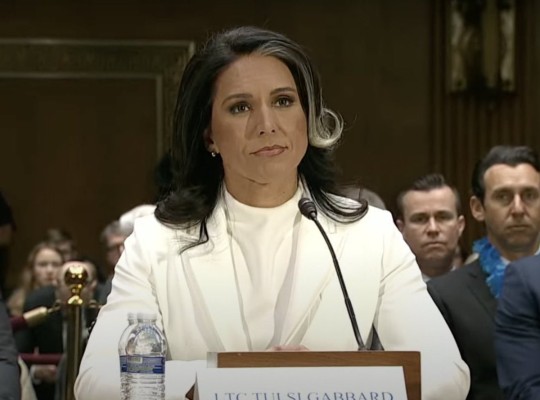
The situation became untenable in the Senate hearing room. Her written statement for a March 18 Senate Intelligence Committee hearing contradicted Trump’s description of Iran’s nuclear weapons program, testifying that “Iran’s nuclear enrichment program was obliterated” and that “there has been no efforts since then to try to rebuild their enrichment capability.” The president and his senior officials had been using Iran’s alleged return to nuclear weapons development as a central justification for the military strikes. Gabbard, as DNI, was publicly undermining the intelligence rationale for the war she was meant to be managing.
“Ineffectual and Irrelevant”: A Brutal Assessment
The Washington media establishment — drawing on intelligence community sources — was scathing. Gabbard quickly came to be seen as ineffectual and irrelevant, and appeared out of place in the Trump administration.
Her tenure was not without action — Trump’s decision to strike Iran had put Gabbard’s anti-interventionist past on a collision course with the administration’s wartime cheerleading. But her attempts to straddle that line — defending presidential authority without endorsing the war — satisfied neither Trump loyalists nor her own anti-war base, according to Axios.
Was She Pushed or Did She Jump?
The honest answer is: probably both, simultaneously. Just a day after Trump fired Attorney General Pam Bondi, reports emerged that he had polled cabinet officials on whether to fire Gabbard — suggesting the axe was hovering. Her husband’s illness gave both sides a dignified off-ramp. Trump’s Truth Social tribute — calling her departure “unfortunate” and saying she’d done “an incredible job” — was perfunctory compared to the warmth he shows true loyalists.
The broader picture is of a Trump cabinet fracturing under the weight of a war that many of the president’s own “America First” picks never signed up for. Gabbard joins a list of anti-interventionist MAGA figures — including Kent — who endorsed Trump expecting restraint and got something very different.
Escaping Trump’s Orbit
Tulsi Gabbard came into Trump’s orbit as a fellow sceptic of endless wars and the intelligence establishment. She ended up running that intelligence establishment, defending a war she privately opposed, and watching her own deputy resign in protest rather than back it. Her letter speaks of love, family, and honour. The subtext speaks of a fundamental incompatibility between who she is and what the second Trump term became.
Follow The Raisina Hills on WhatsApp, Instagram, YouTube, Facebook, and LinkedIn




