


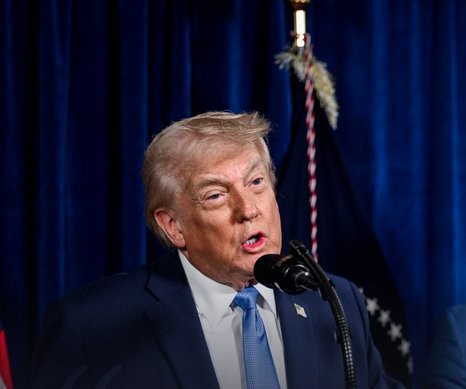
The US president declared progress while reserving the right to strike deeper. A leading security scholar says the contradiction at the speech’s core shows a drift.
By TRH World Desk
New Delhi, April 2, 2026 — US President Donald Trump addressed the nation on the Iran conflict Thursday, framing the campaign as a success nearly sealed. But national security experts heard something different beneath the victory language: a set of conditions that, taken together, describe not an exit but an open door to deeper conflict.
“This speech does not describe the end of a war. It is a leader trying to declare success while preserving freedom to escalate. That combination historically produces longer wars, not shorter ones,” wrote Robert A. Pape, Professor of Political Science, University of Chicago; Founding Director, Chicago Project on Security & Threats (CPOST), in a post on X.
Trump claimed that “core objectives” are nearly achieved but acknowledged the war could continue another two to three weeks — without offering a clear end condition. That framing, Pape argues, is not a sign of confidence. It is the signature of a conflict without a defined terminal point.
The Escalation Ceiling Remains Open
Prior to Thursday’s speech, the administration had floated strikes on Iranian critical infrastructure — including power generation facilities — as leverage tied to compliance demands around the Strait of Hormuz and other strategic pressure points. None of those threats were walked back in the address.
Pape — who has spent decades studying how military campaigns expand beyond their original scope — was direct: “Prior threats include strikes on critical infrastructure like power plants, continued bombardment until strategic compliance. That’s not winding down. That’s raising the ceiling of destruction if Iran resists.”
The Moral Ratchet
Perhaps the most consequential line in the speech, Pape said, was the call to “honor the dead by completing the mission.” The phrase operates as what security scholars call a moral commitment mechanism — each casualty becomes a political argument against stopping.
“That framing locks in political commitment and raises the cost of stopping early,” he said. “Casualties become a moral obligation to continue. It is a classic mechanism: losses lead to a sense of duty, which extends the war.”
A Contradiction at the Centre
The speech presented three claims simultaneously: that the US has “basically won,” that more time is needed, and that further escalation remains possible. Pape argues those statements cannot be reconciled into a coherent strategy.
“Mixed signals about the endgame — that is not strategy clarity,” he said, adding: “That is strategic drift under pressure.”
What to Watch
Pape identified two indicators that will determine whether Thursday’s address was a genuine wind-down signal or a transition to a deeper phase of the conflict: deployment of additional US military assets into the Gulf, and increases in airpower, ground-force protection posture, or logistics infrastructure.
“If those increase,” he said, “this speech wasn’t an exit. It was Stage 2 moving to Stage 3 of the Escalation Trap.”
The Escalation Trap refers to a documented pattern in which early military successes, combined with open-ended political commitments and incremental force additions, draw states into longer engagements than originally intended or publicly stated.
Follow The Raisina Hills on WhatsApp, Instagram, YouTube, Facebook, and LinkedIn




