


By TRH World Desk
Retired Major General S.B. Asthana argues economic interdependence will prevent direct US-China war, while Taiwan remains the central pressure point in the Indo-Pacific.
New Delhi, May 2026 — A fresh geopolitical debate has emerged over the future of the Indo-Pacific after retired Indian Army officer Major General (Dr) S B Asthana posted a detailed strategic monologue on X, arguing that the balance of power around Taiwan is shifting and that the world is entering a prolonged “Cold War 2.0” between the United States and China.
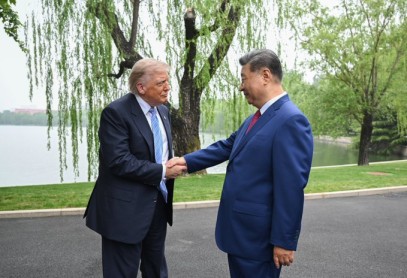
In his remarks, Asthana claimed that recent developments surrounding US President Donald Trump and Beijing reflected a changing strategic reality in the Indo-Pacific, particularly regarding Taiwan.
“The geopolitical situation in Indo-Pacific has changed more than what everybody’s anticipating,” Asthana said, arguing that the US-China rivalry has entered a new phase marked by economic interdependence rather than direct confrontation.
He described the current competition as fundamentally different from the Cold War between the US and the Soviet Union.
“Earlier, Cold War 1.0 between America and USSR had a different dimension because economic dependence was not that strong. In this case, the dependence is tremendous,” he said.
Asthana pointed to trade frictions and supply-chain leverage, particularly China’s role in critical minerals and industrial inputs, to argue that outright conflict remains unlikely despite intensifying strategic rivalry.
“They have to coexist; they cannot confront. Their rivalry will remain, but I don’t think they are going to war with each other,” he stated.
The retired officer also suggested that the emerging world order would be neither purely bipolar nor fully multipolar. Instead, he argued, countries would increasingly pursue independent strategic pathways as traditional alliances become less predictable.
His comments came amid continuing tensions over Taiwan, which Beijing views as part of its territory while Taiwan operates with self-governance and maintains extensive security links with the US and regional partners.
Asthana argued that geography increasingly favours China around the Taiwan Strait and the South China Sea.
“The overall power equation of USA doesn’t match China in this particular area,” he said, noting China’s land-based military advantages near the Taiwan Strait and the first island chain.
However, he stopped short of predicting a Chinese invasion of Taiwan. According to Asthana, Taiwan’s mountainous terrain, limited landing zones and “porcupine defence” strategy make any amphibious assault highly costly.
“It is not going to be an easy task,” he said, while adding that blockade scenarios or pressure on islands closer to mainland China remain plausible options.
The strategic analyst also drew comparisons with past US actions, arguing that Washington’s own use of sanctions and blockades weakened its moral standing on questions of international order.
“I don’t think the US has retained any moral right to give lectures to any country as far as security concerns are concerned,” he said. Asthana cited examples ranging from debates around Greenland and Panama to Middle East conflicts, arguing that major powers increasingly justify actions through national security frameworks.
On India’s position, Asthana strongly endorsed New Delhi’s multi-alignment approach. “We need technology from the USA, raw material from China, oil from the Gulf and many other things from various countries,” he said.
He argued that India should avoid taking rigid sides in what he termed “Cold War 2.0”, maintaining engagement across strategic groupings and economic partnerships.
The retired general also expressed uncertainty over the future reliability of alliance systems under Trump-era unpredictability. Referring to forums such as the Quad, he said: “Everything is a question mark because one doesn’t know how he is going to behave.”
Asthana additionally referenced recent Middle East developments and argued that geography continues to shape conflict outcomes, citing the Strait of Hormuz as an example of strategic leverage.
His remarks add to a growing debate among strategic commentators over whether the US-China competition is entering a new equilibrium: one defined by deterrence, economic rivalry and regional contests rather than direct war.
The Taiwan question remains central to that debate.
While Asthana argued that Beijing may avoid outright military annexation due to costs and risks, he suggested the island still faces strategic uncertainty if great-power bargaining intensifies.
“Taiwan has all the ingredients of an independent country, although not declared one,” he observed, adding that any shift in major-power commitments could leave the island in an uncomfortable position.
For India, however, his conclusion was clear: strategic flexibility rather than bloc politics may define the next phase of global competition.
Follow The Raisina Hills on WhatsApp, Instagram, YouTube, Facebook, and LinkedIn




