


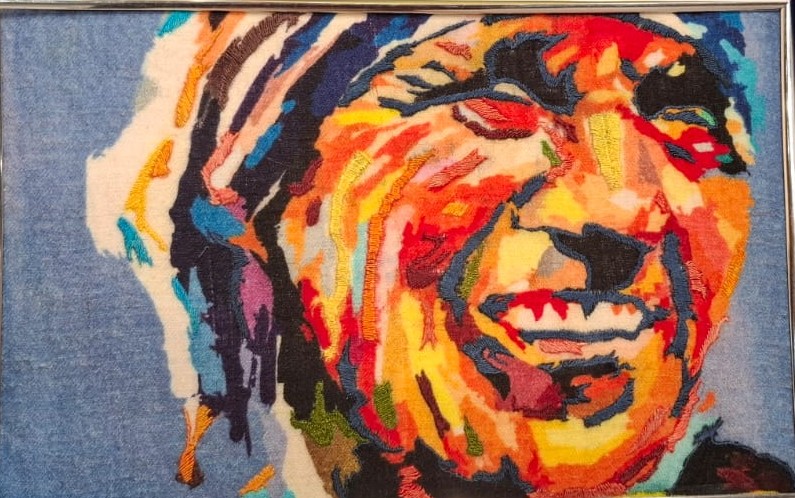
Babar Mohammad Afzal quit tech to live with Ladakh’s nomadic herders — now his pashmina art sells for ₹4.5 crore and his activism is reshaping a dying luxury trade
By BHAWNA MALIK
New Delhi, March 6, 2026 — Babar Mohammad Afzal did not abandon Silicon Valley for solitude or spectacle — but for conscience. When news broke of nearly 25,000 pashmina goats dying of starvation in the high-altitude cold deserts of Ladakh, it unsettled a man whose life revolved around technology, global markets, and predictable success.
What followed was an unlikely transformation — from corporate professional to nomad, from observer to participant, from consumer of luxury to its most uncompromising critic. Today, as founder of Luxury Pashmina Art and The Pashmina Goat Project, he stands at the intersection of art, activism, and heritage.


Disturbed by this imbalance, Afzal made a radical choice — he left Silicon Valley and moved to the high-altitude regions, living as the nomads themselves live.
“I became a nomad to understand what survival truly means. Only when you walk with them, eat what they eat, and face the same winds do you understand the value of pashmina,” Afzal said.
Living in tents, migrating with herders at 14,000 feet, he saw not just an ecological crisis, but a branding failure. “Pashmina is treated as a product — a label slapped onto shawls. But pashmina is a story, a geography, a people, a way of life. It deserves to be a brand,” he said.
His venture works directly with nomadic herders, ensuring fair wages, goat welfare, and climate-resilient practices. Since 2013, Afzal has helped artisans raise their income by 35–40 percent. He calls them “golden hands” — a phrase carrying reverence, responsibility, and regret.
“Gold is valued because it is rare and enduring. So are artisans. Their hands hold centuries of knowledge, yet we treat them as replaceable. A shawl may sell in a boutique for lakhs — but the hands that wove it struggle to educate their children. That contradiction is unacceptable,” he added.
Afzal reserves particular frustration for the fashion industry. “Unfortunately, designers do not have adequate knowledge of this craft. Design should amplify origin, not erase it. If designers shift their mindset — from trend-driven usage to heritage-driven creation — pashmina can evolve into a true global brand,” he said.
As an artist, Afzal works in extraordinary mediums — blood and goat’s hair. “Blood represents life, sacrifice, and truth. When thousands of goats died, it felt like a collective wound that polite conversations could not express. Using blood was not about shock; it was about honesty,” said Afzal. Of goat’s hair he adds: “Wool has memory, texture, and resistance. The process is slow, meditative, and deeply physical — much like the life of a nomad.”
One of his artworks is priced at ₹4.5 crore. “Collectors are not buying an artwork; they are becoming custodians of a narrative,” he said.
On whether art and activism can truly coexist, Afzal is unambiguous: “I don’t separate the two. Art is my language; activism is the message. If my work can help pashmina be seen as a living heritage rather than a commodity, then it has meaning.”
His closing thought distils everything: “If pashmina survives, the nomads survive. And if the nomads survive, a civilisation survives.”
Follow The Raisina Hills on WhatsApp, Instagram, YouTube, Facebook, and LinkedIn




