


By TRH World Desk
Finland’s former PM says Ukraine is “fighting for all of Europe,” but the comparison with Finland’s wars against the Soviet Union needs historical nuance.
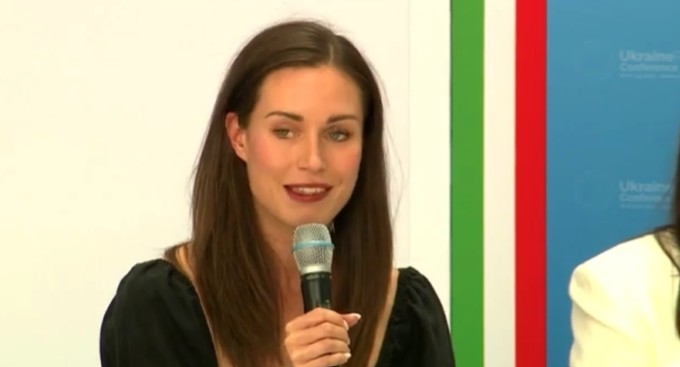
New Delhi, August 29, 2026 — Former Finnish Prime Minister Sanna Marin has put Finland’s own wartime experience with the Soviet Union at the centre of the European debate over Ukraine, thanking Ukrainians for what she described as their sacrifices in defending European security and values.
“I also want to thank Ukraine. Thank you for fighting for all of Europe,” Marin said at an event this week. She added that Ukraine was “in the frontline of defending European values” and argued that “without your commitment and your sacrifices, Europe cannot be safe.”
Marin then invoked Finland’s own history.
Finland, she noted, had experienced “brutal war with Russia or Soviet Union then,” losing territory and lives before eventually building a prosperous country.
The broad historical reference is legitimate. But some of the online commentary attempting to “fact-check” Marin is itself oversimplifying Finland’s wartime history.
Finland’s Winter War Was Not the Same as Ukraine’s War
Finland was invaded by the Soviet Union on November 30, 1939, beginning the Winter War. The conflict ended in March 1940 with Finland retaining its independence but surrendering around 9% of its territory to the Soviet Union. Around 420,000 people were displaced from the ceded territories.
That experience is central to Finland’s modern strategic culture.
For Finns, therefore, the memory of a smaller country resisting a much larger Soviet power is not simply an historical anecdote. It is deeply connected to the country’s contemporary security thinking.
But there is an important second chapter that is sometimes conveniently omitted.
The Complicated Chapter: Finland and Nazi Germany
Finland’s subsequent Continuation War, fought from 1941 to 1944, cannot be understood without acknowledging Finland’s military cooperation with Germany.
After Germany invaded the Soviet Union in June 1941, Finland entered the war against the USSR and recovered territories lost during the Winter War. Historical scholarship describes Finland as joining Germany’s war effort, although the Finnish relationship with Nazi Germany was considerably more complicated than simply describing Finland as a Nazi ally.
This is where some of the internet debate goes wrong.
Equating Finland with Nazi Germany is historically inaccurate. Finland was not Nazi Germany, nor was its political system a copy of Hitler’s dictatorship.
At the same time, pretending that Finland had no military relationship with Germany would also be historically inaccurate. Finnish forces fought the Soviet Union alongside German forces during the Continuation War. Finland eventually made peace with Moscow in 1944 and subsequently fought German forces in the Lapland War.
In other words, Finland’s wartime history is neither a simple morality tale nor an argument for equating Helsinki with Berlin.
The Bigger Point Behind Marin’s Argument
Marin’s central argument is political and strategic rather than historical.
She is essentially saying that Ukraine’s battlefield is Europe’s forward security frontier.
That argument has gained considerable traction across European capitals. European leaders have repeatedly framed Ukraine’s defence as connected to the wider security of the continent. On Ukraine’s Independence Day, European leaders again pledged military and political support to Kyiv, per Reuters.
Finland’s own strategic transformation makes Marin’s argument particularly significant.
Finland abandoned its longstanding military non-alignment and joined NATO in 2023, following Russia’s full-scale invasion of Ukraine. Its 1,340-kilometre border with Russia has consequently become one of NATO’s most strategically important frontiers, added Reuters in a report.
And the security environment remains tense. Sweden is now deploying fighter aircraft and a warship to Finland to strengthen territorial surveillance and defence cooperation, underlining how Nordic security planning has changed since Russia’s invasion of Ukraine.
“Fighting for All of Europe” — Rhetoric or Reality?
Marin’s phrase that Ukraine is “fighting for all of Europe” is, of course, political rhetoric. Ukraine is fighting primarily for its own territory, sovereignty and national survival.
But there is a strategic logic behind the rhetoric.
If Russia’s invasion succeeds in permanently altering European borders through force, European governments fear that the precedent could weaken the continent’s post-1945 security architecture.
That does not mean every European country is literally at war with Russia. Nor does it erase legitimate debates over the scale, duration and cost of Western military assistance to Kyiv.
The more useful question is therefore not whether Ukraine is literally fighting for every European country, but whether the outcome of the war will affect Europe’s future security order.
For Finland, that question is hardly theoretical.
A country that once fought the Soviet Union, lost territory, preserved its independence and subsequently built a prosperous democracy now finds itself sharing NATO’s long frontier with Russia.
That history gives Marin’s words considerable political weight.
But it also demands historical precision.
Finland’s experience cannot simply be transplanted onto Ukraine’s war. The Winter War, the Continuation War, Finland’s cooperation with Germany, the subsequent Lapland War and the eventual post-war settlement were all products of a very different European order.
The lesson from Finnish history may therefore be less about choosing simplistic historical parallels and more about understanding how small and medium-sized European states adapt when the balance of power around them changes.
Ukraine War: Russian Soldiers’ Survival Time Shrinks Amid Drone Attacks
Follow The Raisina Hills on WhatsApp, Instagram, YouTube, Facebook, and LinkedIn




