


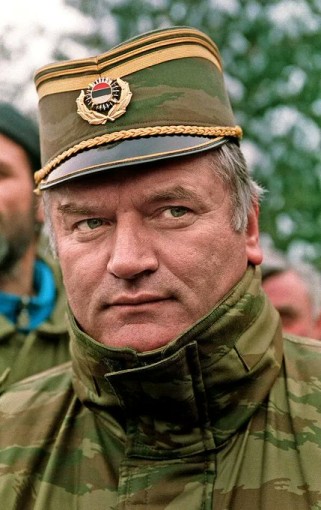
By TRH World Desk
The former Bosnian Serb general, convicted of genocide for orchestrating the Srebrenica massacre, has died while serving a life sentence in The Hague — closing the final chapter on one of Europe’s most notorious war crimes cases.
New Delhi, August 27, 2026 — Ratko Mladić, the Bosnian Serb military commander whose forces carried out the worst massacre on European soil since the Second World War, died Thursday in a United Nations prison hospital in The Hague, Netherlands. He was 84.
Mladić’s death was confirmed by Serbian state broadcaster RTS, with a family member later confirming the reports to the Associated Press and saying Mladić’s son, Darko, was on his way to The Hague. The Guardian reported Mladić had been in declining health after suffering a series of strokes in his final years.
Who Was Ratko Mladić
Mladić was the son of a Second World War partisan fighter killed in 1945, and trained as an officer in the communist Yugoslav People’s Army before Yugoslavia’s disintegration began in 1991. When Bosnian Serbs rose up in 1992 against Bosnia’s Muslim-led secession, he was chosen to command the newly formed Bosnian Serb army, which swiftly overran roughly 70% of the country. The Guardian described how his forces besieged dozens of towns and cities with heavy weaponry inherited from the old Yugoslav army, burning villages as a 22,000-strong UN Protection Force stood by largely helpless to intervene.
Mladić’s forces laid siege to Sarajevo for more than three years, subjecting the city to sustained shelling and sniper fire that killed thousands of civilians. When NATO attempted to rein in his forces with the threat of limited airstrikes in 1995, The Guardian reported his troops responded by seizing UN peacekeepers as human shields, chaining them to likely bombing targets.
The Srebrenica Genocide
The defining atrocity of Mladić’s command came in July 1995, when his forces overran the UN-designated “safe area” of Srebrenica and systematically executed more than 8,000 Bosniak (Bosnian Muslim) men and boys — an event Euronews described as the worst atrocity on the continent since the end of World War II. Footage from the period, cited in European reporting on his conviction, showed Mladić personally handing out sweets to children shortly before the women and children of the town were bused away and the men marched into nearby forests to be shot.
Mladić spent 15 years as a fugitive before his eventual capture in Serbia in 2011. He was tried by the International Criminal Tribunal for the former Yugoslavia (ICTY), which sentenced him to life imprisonment in 2017, and his conviction was upheld on appeal in 2021.
Reaction to His Death
The reaction across the region reflected the enduring, unresolved pain of the war. Munira Subasic of the Mothers of Srebrenica association, who lost family members in the massacre, offered a stark assessment on Mladić’s death: “Today, a major war criminal died, the criminal of the Balkans,” she said, according to reporting on the reaction, adding that survivors are “still carrying the pain in our souls” more than three decades on, and remain frustrated that Mladić’s crimes continue to be denied by many Bosnian Serbs.
Christiane Amanpour, a CNN journalist, wrote on X: “…Mladić lived way longer than he allowed his tens of thousands of victims. The more than 7000 Muslim men and boys he had slaughtered in Srebrenica will be his enduring shame. At least he was tried by an International Criminal Tribunal and found guilty of his enormous crimes of genocide.”
She further stated: “I am proud of the work we journalists did in the 90s to document his crimes against humanity, to finally hold him accountable.”
That tension — between formal justice and continued denial — has followed Mladić since his original conviction. A commentary published in the Guardian around the time of his 2017 sentencing captured the ambivalence many survivors felt even in victory, noting that while human rights organizations and lawyers celebrated his conviction, most who survived his campaign of violence continued to live under what the piece described as a lasting shadow, with the general still regarded as a hero by many Bosnian Serbs in the territory his forces once controlled.
The End of an Era in War Crimes Accountability
Mladić’s death closes out one of the most significant chapters in post-Cold War international justice. Alongside his political counterpart Radovan Karadžić — who remains in custody — Mladić’s prosecution represented the ICTY’s most high-profile effort to hold the architects of the Bosnian War’s ethnic cleansing campaign personally accountable, decades after the conflict itself ended. With his death, no further legal proceedings, appeals, or sentence reviews will follow; the historical and moral reckoning over his crimes, and Bosnia’s fractured postwar politics, continues.
Follow The Raisina Hills on WhatsApp, Instagram, YouTube, Facebook, and LinkedIn




