


By TRH Op-Ed Desk
India’s extended chairmanship, a $1 billion port in Fiji, an ocean surveillance pact, and a critical minerals deal emerged from the 11th Quad Foreign Ministers’ Meeting — but geopolitics analyst Manish Anand says the group’s momentum hinges on Washington’s sincerity
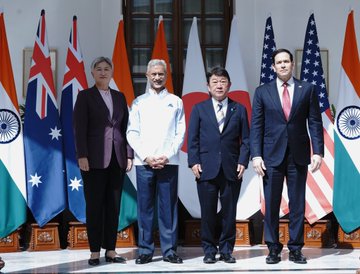
New Delhi, May 27, 2026 — The four foreign ministers of the Quad grouping met in New Delhi on Tuesday and walked away with three concrete outcomes: a new maritime surveillance initiative, a critical minerals framework, and the grouping’s first-ever joint infrastructure project — a port in Fiji. But the headline numbers may not tell the full story.
“Quad is alive — it has not died. That is the single biggest message from the foreign ministers’ meeting held in New Delhi,” said Manish Anand, geopolitics analyst and host of The Raisina Hills on YouTube. “But the fact that India’s Quad chairmanship, which began in 2025, is now extending to nearly two years instead of one — that is not an achievement. That is not good news. It shows, somewhere, that America’s interest is diverted,” he added.
Anand’s assessment cuts through the diplomatic optimism surrounding the meeting. The Quad had lost some momentum last year after failing to hold a leaders’ summit, amid friction between US President Trump and Prime Minister Modi over US tariffs and other matters. Rubio indicated over the weekend that diplomats would work towards a leaders’ meeting later this year, though foreign ministers declined to confirm. “Australia, Japan, and India’s commitment is clear,” Anand said. “But America’s commitment — that is where the deficit is visible.”
Despite the scepticism, Anand identifies the three outcomes as genuinely significant — all pointing, in his reading, at a single adversary.
First: Indian Ocean Maritime Surveillance. The Quad partners launched the first ever Indo-Pacific Maritime Surveillance Collaboration (IPMSC) initiative to leverage Quad country maritime surveillance in the Indo-Pacific, enhancing information sharing and maritime domain awareness capacity with an initial focus on the Indian Ocean Region. “The Indian Ocean has always been India’s zone of influence,” Anand said. “The Indian Navy has historically been the proactive force for maritime security in that region.” He noted that America’s recent unilateral naval actions in the Indian Ocean — particularly during its sanctions enforcement against Iranian oil shipments — had raised uncomfortable questions about Washington’s respect for India’s traditional sphere. The new framework, he argues, formalises India’s central role while anchoring American engagement within a multilateral structure.
Second: The Fiji Port. The Quad countries will work, in coordination with the Government of Fiji, to advance port infrastructure and associated activities in the country. Anand calls this the first truly concrete infrastructure move the Quad has attempted. “Until now, only statements came out of Quad meetings. This time, for the first time, it appears something will actually be built on the ground,” said Anand. He frames the project squarely against China’s Belt and Road Initiative, which has methodically seeded port infrastructure from the Pacific to the Indian Ocean. “Australia’s anxiety is the deepest here — China’s growing naval presence in the Pacific islands has been a persistent concern for Canberra,” added Anand.
Third: Critical Minerals Framework. Key outcomes also included a critical minerals initiative to strengthen cooperation between member states. “China used critical minerals as geopolitical leverage — restricting exports to influence the global order,” Anand said. “For all four Quad nations to come together specifically on critical minerals mining, processing, and technological transfer is a positive outcome. Concrete deliverables from this are something we can look forward to,” he stressed.
Anand also highlights a subtle but significant diplomatic signal in how US Secretary of State Marco Rubio was received during his five-day India visit. “The reception that was given to Rubio in India — in Agra, in Jaipur — was done by officials, not senior political leadership,” he noted. “India’s Foreign Ministry sent a very clear message: the way you treat us in America is exactly the way you will be treated here.”
On counter-terrorism, the Quad joint statement unequivocally condemned terrorism in all its forms and manifestations, including cross-border terrorism and the horrific terrorist attacks perpetrated at Pahalgam in India. Yet Rubio’s assertion that Pakistan was also a “victim” of terrorism drew sharp scrutiny. “The Trump administration’s tilt towards Pakistan has not diminished,” Anand said. “That is obvious. And they say it openly.”
On trade, Rubio’s claim at a New Delhi press conference that India had agreed to purchase $500 billion worth of American goods over five years remains unconfirmed by New Delhi. “India’s Foreign Ministry has issued no such statement,” Anand said. “This gap is significant — and unresolved.”
The bottom line, in Anand’s assessment: “The Quad has certainly received a lifeline. There is momentum. But in terms of substance — there is still more work to be done.”
(This report draws on analysis by Manish Anand, geopolitics commentator and host of The Raisina Hills YouTube channel.)
The Quad Gathers in New Delhi: A Grouping Finding Its Footing
Follow The Raisina Hills on WhatsApp, Instagram, YouTube, Facebook, and LinkedIn




