


By TRH Political Desk
Political analyst Manish Anand argues that PM Modi’s Red Fort speech reflects nervousness, a shortage of new ideas and an attempt to reconnect with a restless youth constituency.
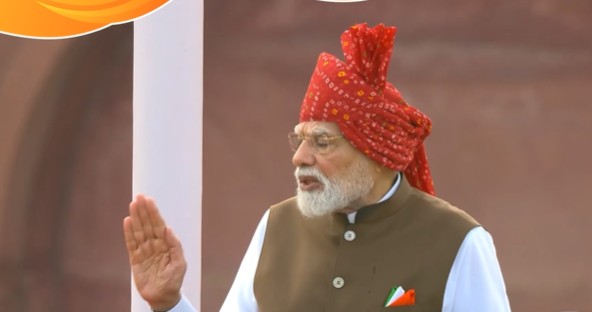
New Delhi, August 15, 2026 — Prime Minister Narendra Modi’s Independence Day speech from the Red Fort appears to have come as a crisis response, according to political analyst Manish Anand. The speech, he argues, reflects an attempt by the Modi government to respond to a youth constituency that is increasingly asserting itself on the streets.
“The youth on the street has ruptured the Modi governance model,” Anand says, arguing that the political challenge facing the government is no longer simply about projecting achievements but about reconnecting with a generation that may be increasingly sceptical of the existing political narrative.
For Anand, the Red Fort speech was a “desperate dial” to shine Modi’s achievements and connect with the youth. The Prime Minister appeared to labour to establish that Gen Z is at the centre of the Modi government’s political and governance agenda.
Yet, Anand believes, the speech also exposed a deeper problem: a drought of new political ideas.
“Overall, PM Modi has run out of ideas,” Anand says.
Inventing a new enemy
One of the most significant elements of the speech, according to Anand, was the attempt to create a new political enemy for the BJP’s followers — the Maoists, particularly the “dimaagi Maoawadi”.
Anand interprets Modi’s message on the Jantar Mantar protests through this political lens: “Must defeat ‘Dimagi Maowadi’.”
For him, the political goal appears to be shifting towards identifying an ideological enemy.
“Modi’s speech invents an enemy for BJP followers: Maowadis,” Anand says.
But the attempt at political labelling also indicates nervousness, he argues. The government appears to be reaching for an old political toolkit at a time when the nature of the challenge is changing.
“Gen Z may hardly connect with this script. Labelling is old toolkit now,” Anand says.
Partition’s Bloody Legacy: Why the Indian Subcontinent Never Really Recovered
A bouquet of tepid promises
The other major component of the speech was its attempt to appease the youth through promises.
Anand describes these as a “bouquet of tepid promises”, suggesting that the government is attempting to address youth concerns while simultaneously trying to preserve its established political narrative.
The speech, in Anand’s assessment, sought to portray Modi as a saviour — a leader who has guided India through Covid and regional and global wars, with these crises forming important subtexts of the larger political script.
At the same time, the Prime Minister continued to present himself as a welfarist leader through schemes.
But Anand sees a contradiction between this familiar political narrative and the changing expectations of young Indians.
“The Modi Red Fort speech came as a crisis response,” he says. “There is a desperate dial to shine his achievements and connect with the youth.”
The education crisis and online coaching
Anand is particularly critical of the government’s response to the education crisis. “Modi’s response to education crisis: online coaching,” he says.
For Anand, the rise of coaching itself points towards the deeper problem. “Coaching thrives because school education is now struggling,” he added.
The argument is that online coaching cannot, by itself, address the underlying crisis in education. If coaching has become so central to students’ aspirations, it also reflects the difficulties within the formal education system.
“This government sounds highly disconnected with the reality,” Anand says.
A government searching for a new script
Taken together, Anand sees the Red Fort speech as evidence of a government attempting to recalibrate its political messaging.
On one side is the familiar Modi narrative of achievements, welfare schemes and the Prime Minister as a crisis-era saviour. On the other is an attempt to speak directly to Gen Z through promises aimed at the youth.
Running alongside both is the emergence of the “dimaagi Maowadi” as a new political adversary.
For Anand, this combination reveals the central weakness of the speech: the absence of a genuinely new idea to address the concerns driving young people onto the streets.
“The Prime Minister sounds like he is suffering from a new idea drought,” Anand says.
The Red Fort speech, therefore, may have been intended to project confidence and continuity. But in Anand’s reading, it also revealed nervousness — a government trying to appease the youth with promises while simultaneously falling back on political labelling.
“Overall, PM Modi has run out of ideas.”
(Views expressed are those of Manish Anand.)
Exam Reform to Youth Power: Key Takeaways From President Murmu’s Address
Follow The Raisina Hills on WhatsApp, Instagram, YouTube, Facebook, and LinkedIn




