


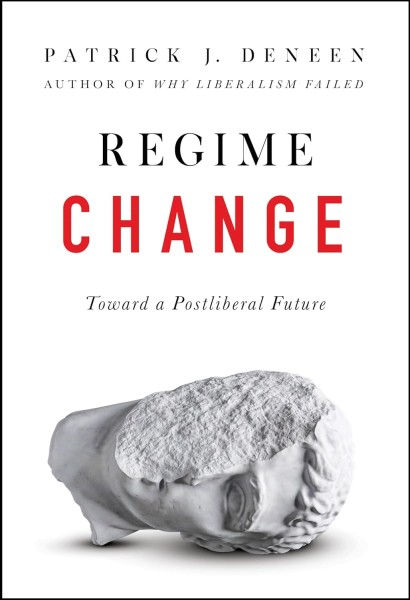
Book Desk. Author: Patrick J. Deneen. Publisher: Sentinel (Penguin Random House)
Published: June 6, 2023. Pages: 269. ISBN: 978-0-593-08690-2. Price: $30.00
Patrick J. Deneen is not a man who does things by halves. The Notre Dame professor of political science and constitutional studies arrived on the mainstream intellectual scene in 2018 with Why Liberalism Failed, a scathing autopsy of the liberal democratic order that was debated in magazine sections across the country and promoted on Barack Obama’s personal reading list. Now, with Regime Change: Toward a Postliberal Future, Deneen attempts something even more audacious: he moves from diagnosis to prescription, from tearing down to building up. The result is a short, fiery, intellectually provocative, and deeply contested book that has managed to simultaneously fascinate and infuriate readers across the ideological spectrum.
Published by Sentinel, a conservative imprint of Penguin Random House, Regime Change arrives at 269 pages and makes no pretense of neutrality. It is a manifesto — carefully sourced in ancient political philosophy but charged with the urgency of a contemporary polemic. For those who thought Why Liberalism Failed was provocative, Regime Change raises the stakes considerably.
Context: Building on Why Liberalism Failed
To understand Regime Change, one must first understand its predecessor. Why Liberalism Failed argued that liberal democracy was not merely experiencing a crisis but was suffering from a fatal internal contradiction: the very freedoms it promised had corroded the communal structures — family, church, local civic life — that make meaningful human existence possible. That book earned Deneen an unusual bipartisan readership: populist conservatives nodded along at its critique of the managerial class; communitarian leftists found resonance in its critique of atomized individualism.
Regime Change presupposes that debate and moves past it. Where Why Liberalism Failed was a diagnostic work, Regime Change is, in Deneen’s own framing, the cure. He has said as much: if the earlier book supplied the diagnosis, this one recommends the treatment. This is an important framing, because critics of the new book have noted that it is far more vulnerable, far more exposed to challenge, than its predecessor. Diagnosing a problem is intellectually safer than prescribing a solution, and Deneen’s proposed solution — what he calls “aristopopulism” — has drawn fire from nearly every direction.
The Central Argument: Aristopopulism and the Mixed Constitution
Deneen’s thesis, stripped to its essentials, is this: classical political philosophy — particularly the tradition running from Aristotle through Polybius, Cicero, Aquinas, Machiavelli, Burke, and Disraeli — identified the fundamental problem of political life as the tension between “the few” and “the many.” The great insight of this tradition was that the wisest regimes were “mixed constitutions” that balanced oligarchic and democratic tendencies, preventing either class from dominating the other.
Liberal democracy promised to solve this problem permanently through rights, markets, and meritocracy. Instead, it created a new and arguably more insidious ruling class — one that justifies its dominance not through hereditary privilege but through credentials, credentials that are themselves accessible primarily to those born into privilege.
This new elite, Deneen argues, is defined by its “economic libertarianism, progressive values, and technocratic commitments,” and it governs for its own benefit while gesturing toward the language of equality and opportunity. The meritocracy, he insists, is a myth — or rather, a self-perpetuating machine. As the New York Times noted in its review, Deneen’s account describes how “after spending 150 pages disparaging the ‘elite,’ Deneen goes on, in the last third of the book, to try to reclaim the word for a ‘self-conscious aristoi’ who would dispense with all the liberal niceties about equality and freedom and instead serve as the vanguard of a muscular ‘aristopopulism.’”
The remedy Deneen envisions is not a return to pre-modern hereditary aristocracy but the deliberate cultivation of a new elite — a “pre-postmodern conservatism” — whose members are formed by classical education and civic virtue rather than by professional credentialing and progressive ideology. This new aristocracy would govern not for itself but as genuine stewards of the common good, aligning its interests with those of the working class rather than exploiting them.
The key term Deneen coins for this arrangement is “aristopopulism”: a blending, or “melding,” of conservative elite leadership and working-class populist energy into a new political arrangement. He draws on Machiavelli’s Discourses on Livy to argue, in his own words, that what is needed is “the application of Machiavellian means to achieve Aristotelian ends — the use of powerful political resistance by the populace against the natural advantages of the elite to create a mixed constitution … in which genuine common good is the result.”
Muskism Review: The Book That Reframes Elon Musk as a System
Strengths of the Book
The Critique of Meritocracy
Deneen is at his sharpest when he dissects the liberal myth of meritocracy. His argument that the liberal order replaced the restraints of birthright with the restraints of credentialism — and that the latter are scarcely more egalitarian than the former — is genuinely powerful.
The observation that elite universities, which claim to democratize opportunity, admit a tiny fraction of applicants and charge enormous sums to attend, is a pointed and effective illustration of liberalism’s self-contradiction. Kirkus Reviews noted that his critique of those institutions carries real weight, even if his proposed alternatives are less persuasive.
The Recovery of Classical Political Philosophy
Whatever one thinks of Deneen’s conclusions, his command of the Western philosophical tradition is formidable. The book moves fluently through Aristotle’s Politics, Polybius’s theory of the mixed constitution, Tocqueville’s analysis of the ancien régime, and Burke and Disraeli’s one-nation conservatism. For readers unfamiliar with this tradition, Regime Change serves as a genuine introduction to ideas that mainstream political discourse has largely abandoned.
The Law and Politics Book Review (Washington and Lee University) acknowledged that “Deneen is observing simply the latest manifestation of Marx’s class tensions” but with a sharpness that warrants serious engagement.
Naming a Real Problem
Virtually every reviewer, sympathetic or hostile, has conceded that Deneen’s diagnosis of genuine social fracture is not invented. The loss of community, the decay of small towns, the hollowing out of civic institutions, the collapse of working-class social structures — these are real phenomena, documented by sociologists, economists, and journalists across the political spectrum.
Modern Age Journal noted that outside the leading organs of mainstream commentary, “much of the culture, from high art to pop novels and films, indicates uneasiness with existing systems,” and that nearly 65 percent of Americans believe the country is on the wrong track. Deneen is writing into a real void of meaning, and the urgency of that project deserves recognition.
Intellectual Provocation
Regime Change is, as the Los Angeles Review of Books grudgingly acknowledged, a book that must be taken seriously even by those who strongly disagree with it. It has attracted blurbs from Harvard Law’s Adrian Vermeule, who called it “a brilliant and clarifying success,” and from Cornel West, who praised Deneen’s “common-good conservatism” as “a gallant effort to preserve crucial aspects of our desiccated democratic tradition.”
The range of serious interlocutors, from left to right, is itself testimony to the book’s intellectual weight.
Weaknesses and Criticisms
The Vagueness of Aristopopulism
The most consistent criticism of Regime Change across American outlets is that Deneen’s proposed remedy is underspecified to the point of incoherence. The New York Times reviewer observed that Deneen “offers a vague reassurance that the ‘raw assertion of political power’ would somehow be wielded in a ‘peaceful but vigorous’ way.”
The New Republic concluded bluntly that “despite his weakness for abstraction and overstatement, (Deneen) is a serious historian of ideas … This is where Deneen’s argument becomes incoherent. He is strong on rhetoric, but weak on policy prescriptions.”
How exactly does one cultivate a new aristocracy animated by civic virtue rather than self-interest? Who selects the new aristoi? By what mechanism does their leadership remain accountable? These questions hover unanswered over much of the book.
Regime Change: The Trump Book That Even Trump Was Waiting For — With Dread
The Hungary Problem
Deneen’s citation of Viktor Orbán’s Hungary as a model for family-friendly, birth-rate-promoting governance has attracted sharp criticism. Kirkus Reviews called it “unfortunate that one of the examples of family formation and birth-rate-promoting government that Deneen holds up is the far-right Orban regime of Hungary.”
The Institute for Christian Socialism review noted that Deneen’s proposed new aristocracy “will roll back the hard-won liberal rights of sexual and gender minorities,” modeling itself on “soft-authoritarian regimes like Orban’s Hungary — where Deneen paid a respectful visit.” For a book that insists it is not advocating authoritarianism, the Hungary reference lands poorly.
Straw-Manning Liberalism
Multiple US reviewers noted that Deneen treats “liberalism” as a monolithic entity rather than a genuinely contested tradition. Book Marks aggregated a range of critical responses, with reviewers noting that “Deneen’s disregard for details, among them the awkward fact that no one actually defends the position he attributes to practically everyone, is unfortunately characteristic.”
The New York Times observed that the book’s “prolix ‘to be sures’” around issues of race, gender, and equality are “so conspicuously awkward” as to be a tell: the reassurances suggest awareness of the book’s vulnerabilities rather than genuine engagement with them.
The “Machiavellian Means” Problem
Among the most alarming passages for many critics is Deneen’s invocation of Machiavelli’s language about methods that are “extralegal and almost bestial” — even if Deneen frames this as historical reference rather than personal recommendation.
The National Catholic Reporter flagged the passage explicitly, noting that while Deneen “surely” does not intend to endorse violence or extralegal activity, his preference for Machiavellian framing without adequate qualification raises uncomfortable questions, particularly in the post-January 6 political landscape.
Intellectual Dishonesty
Several American reviewers went further than mere disagreement. The New Republic charged that “the newer book contains all the faults of Why Liberalism Failed but adds one: dishonesty,” arguing that Regime Change, unlike its predecessor, “appears to be written exclusively for people who already agree with its contentions.”
Open Letters Review concluded that the book “is a philosophy of anti-progress and anti-freedom … a message to ‘the people’ from a courier who eyes the liberal order with the impatience of a Jacobin, but in its stead desires a new elite enforcing state and religious edicts.”
The Political Context: From Fringe to Power
One cannot read Regime Change in 2023 — or review it now — without noting that Deneen’s ideas have moved from the seminar room into the corridors of power. The book was blurbed by then-Senator J.D. Vance, who wrote that Deneen “articulates a vision for a populist politics that can rebuild what has been torn down.”
Sohrab Ahmari, founder and editor of Compact magazine, called it a work that “reaffirms (Deneen’s) status as the West’s most important political theorist.” Deneen has been described by The Wall Street Journal as an “ideological guru” of the Trump administration. This political context does not determine the book’s intellectual value — ideas must be evaluated on their own terms — but it does sharpen the stakes.
When a book’s author is described as an ideological influence on a sitting administration, the question of whether its ideas are coherent and honest becomes not merely academic.
Style and Prose
One point on which even hostile reviewers agree: Deneen writes well. Modern Age noted his “fluent, fiery prose that mixes moral exhortation, anti-liberal polemic, and philosophical critique.”
The prose is direct, aphoristic, and passionate — a refreshing contrast to the hedged, footnoted circumspection of most academic political theory. Whether that clarity is an intellectual virtue or a rhetorical sleight of hand — using confident prose to paper over unresolved arguments — is itself a matter of debate.
Open Letters Review suggested that Deneen’s “out-of-control italics usage” and “sweeping pronouncements about the entirety of culture since the dawn of time” were markers of a “bad political theorist” who had substituted rhetorical energy for rigorous argument.
Who Should Read This Book?
Regime Change is essential reading for anyone who wants to understand the intellectual currents driving the American right in the mid-2020s. Whether or not one finds Deneen’s argument persuasive — and a large majority of serious reviewers in the United States did not — the book is a serious and influential intervention in the debate about liberalism’s future. It is particularly recommended for:
- Students of political philosophy who want to see classical republican thought applied to contemporary problems.
- Readers across the political spectrum who are genuinely troubled by the failures of liberal democracy and are searching for serious alternatives.
- Those who want to understand the postliberal right
- its intellectual foundations, its ambitions, and its blind spots.
- Anyone engaged in debates about meritocracy, class, and elite formation in contemporary America.
It is not recommended for readers seeking a practical policy roadmap; the book is more prophetic than programmatic, more diagnostic (still) than genuinely prescriptive.
Verdict
Regime Change is a book of genuine intellectual ambition that ultimately falls short of its aims. Patrick Deneen is at his best when he channels his deep reading in classical political philosophy into a critique of liberalism’s self-defeating meritocracy and the atomization of working-class life.
He is at his worst when he gestures, with insufficient specificity, at an “aristopopulist” solution whose institutional mechanisms remain a mystery, and when his reassurances about racial and gender equality feel perfunctory rather than earnest.
The Wall Street Journal called it “absurd and perverse.” The New York Times found it “chilling.” The Los Angeles Review of Books labelled it “insidious and dangerous.” These verdicts are harsh, and in some cases unfair to the book’s genuine contributions. But the critics are right that Deneen has not yet made the affirmative case for his post-liberal order with anything approaching the rigor and care he brings to his critique of the liberal one. As a polemic, Regime Change is powerful. As a blueprint, it remains conspicuously unfinished.
Rating: 3 out of 5 stars
A provocative and necessary read — but one that raises more questions than it answers.
Regime Change: The Book That Exposes How Trump Rewired the American Presidency
Follow The Raisina Hills on WhatsApp, Instagram, YouTube, Facebook, and LinkedIn




