


By TRH World Desk
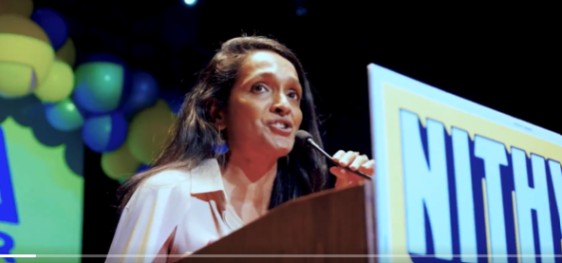
From trailing by double digits on election night to overtaking Spencer Pratt and advancing to the November runoff, Nithya Raman’s surge in the LA mayoral race is more than a comeback story — it’s a referendum on the future of the Democratic Party.
New Delhi, June 11, 2026 — In politics, a week is a long time. In Los Angeles, the last ten days have felt like a decade. What began as a comfortable lead for former reality TV star Spencer Pratt on election night has unravelled into a 22,000-vote deficit — and what began as a long-shot challenge from a progressive city councilmember has become something far more consequential: a November face-off between two Democratic women that will determine not just who runs America’s second-largest city, but what kind of Democratic Party survives in the age of Trump.
The numbers tell the tale. On the night of the June 2 primary, Pratt held a commanding lead over Nithya Raman for the second runoff spot. But as Deadline noted, this was “a true Hollywood reversal of fortune” — by Monday, June 9, the Associated Press had projected Raman’s advancement to the general election after she reached 28.56% of the counted vote to Pratt’s 25.83%, a swing that left the Trump-endorsed celebrity candidate effectively finished in a city where fewer than 15% of voters are registered Republicans.
ABC7 Los Angeles confirmed the projection, reporting that with 93% of expected votes counted, Raman had locked in her place on the November ballot.
Raman’s surge was stoked by a characteristic of California’s mail-in ballot system that her campaign clearly understood better than Pratt’s: late-arriving ballots consistently skew toward organised, well-networked progressive campaigns.
As NBC Los Angeles reported, Raman had been “eating into Pratt’s lead ever since election night,” receiving twice as many votes as Pratt in the Friday batch alone.
The message from her campaign was disciplined and confident: “We are encouraged by the latest vote count and remain grateful to the thousands of Angelenos who have powered this campaign,” Raman said in a statement to NBC LA.
Now she faces incumbent Mayor Karen Bass in November — a contest that is, at its core, a Democratic civil war. Bass’s campaign did not waste a moment projecting gracious congratulations. Instead, spokesperson Alex Stack issued a combative statement, quoted by Deadline: “We look forward to winning a contest against an opponent who allows encampments near schools and fights against hiring more cops, yet is MIA on saving Hollywood jobs and fighting back when ICE invades LA.” The gloves, in other words, are already off.
But understanding why Raman’s rise matters requires looking beyond the horse-race numbers. As TIME magazine reported in its profile of the candidate, Raman described her 2020 City Council campaign as an “outsider” effort “run without a political machine” — one that toppled incumbent David Ryu, who had been endorsed by Hillary Clinton and Nancy Pelosi, while drawing support from younger voters anxious about rent and cost of living. She went on to become the first South Asian and Asian American woman ever elected to LA City Hall, as LA Public Press documented.
That background — a Harvard and MIT-educated urban planner, a former director of Time’s Up Entertainment, a founder of a homelessness services nonprofit — is central to the challenge she poses to Bass.
Where Bass represents a traditional Democratic machine that has struggled to contain the city’s homelessness crisis, its $1 billion budget gap, and the devastating aftermath of the Pacific Palisades wildfires, Raman offers an argument rooted in systemic reform.
As The Hill reported, even while announcing her candidacy, Raman struck a careful tone: “I have deep respect for Mayor Bass. We’ve worked closely together on my biggest priorities and her biggest priorities, and there’s significant alignment there.” Translation: the disagreement is not personal. It is structural.
The national implications are not subtle. Deadline noted that MAGA loyalists including JD Vance and Mike Johnson began attacking California’s vote-counting process with no evidence — a familiar template — the moment Raman’s lead solidified.
Dan Schnur, a political communications professor at USC, Berkeley, and Pepperdine, told NBC Los Angeles that Raman winning the runoff spot “would present challenges for Bass’ campaign strategy,” since Bass’s team had spent months calibrating their attacks against Pratt.
What Nithya Raman has achieved so far is not simply a primary comeback. In a Democratic Party still searching for its post-Biden identity, her surge signals a real and restless appetite — in America’s entertainment capital, no less — for the kind of insurgent, policy-driven progressivism that establishment politics has long tried to contain. Whether she can sustain it against an incumbent with deep institutional backing between now and November is the central question of the most consequential mayoral race in the country right now.
Follow The Raisina Hills on WhatsApp, Instagram, YouTube, Facebook, and LinkedIn




