


By TRH Foreign Affairs Desk
Prime Minister Narendra Modi and Iranian President Masoud Pezeshkian discussed bilateral ties, Chabahar, trade and the West Asia crisis, with India reiterating its call for dialogue, diplomacy and freedom of navigation.
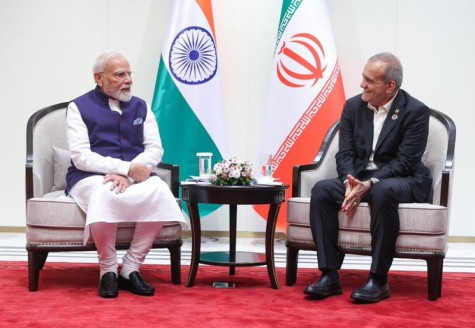
New Delhi, August 31, 2026 — Prime Minister Narendra Modi’s meeting with Iranian President Masoud Pezeshkian on the sidelines of the Shanghai Cooperation Organisation (SCO) Summit in Bishkek has underlined New Delhi’s effort to preserve and deepen its longstanding relationship with Tehran amid continuing instability in West Asia.
The meeting assumed added significance as India reiterated its position that regional disputes must be addressed through dialogue and diplomacy, while also stressing the importance of freedom of navigation and uninterrupted commerce.
In a post on X, Modi said he had a “fruitful meeting” with Pezeshkian and reiterated India’s commitment to strengthening its longstanding friendship with Iran across diverse sectors.
“We want to expand and diversify our trade basket in the times to come,” Modi said, adding that the two leaders discussed the prevailing situation in the region and that India would continue supporting efforts aimed at ensuring lasting peace.
The Ministry of External Affairs said the two leaders reviewed various aspects of bilateral relations as well as recent developments in West Asia.
MEA spokesperson Randhir Jaiswal said Modi and Pezeshkian discussed bilateral ties and the regional situation during their meeting on the sidelines of the SCO Summit.
“Prime Minister reiterated India’s consistent position that all issues must be resolved through dialogue and diplomacy,” Jaiswal said.
Modi also underlined the need for continued efforts to ensure peace and stability and stressed the importance of safeguarding freedom of navigation and commerce.
The emphasis is particularly significant for India because developments in West Asia have implications not only for regional security but also for energy supplies, shipping routes and India’s commercial interests.
Pezeshkian calls for deeper India-Iran cooperation
The Iranian readout of the meeting placed considerable emphasis on expanding bilateral cooperation.
Pezeshkian expressed Iran’s readiness to further develop and deepen relations with India across political, economic, scientific, cultural and other areas.
The Iranian president also highlighted the potential for greater economic and trade cooperation despite sanctions and external restrictions.
According to the Iranian readout, Pezeshkian argued that India and Iran possess extensive capacities for expanding cooperation and that stronger bilateral ties could help neutralise the effects of sanctions.
He also called for stronger communication and consultations between officials of the two countries.
Chabahar remains strategically important
Transportation and maritime cooperation, developments related to the Strait of Hormuz and progress at Chabahar Port featured among the issues discussed by the two leaders, according to the Iranian side’s readout.
For New Delhi, Chabahar has long represented an important connectivity link with Iran and the wider region.
The port provides India with a potential route towards Afghanistan and Central Asia that reduces dependence on traditional overland routes through Pakistan.
The reference to maritime affairs and the Strait of Hormuz also adds another layer to the meeting. Any prolonged disruption in one of the world’s most strategically important energy and shipping corridors can have consequences well beyond West Asia.
India’s emphasis on freedom of navigation and commerce therefore reflects both a diplomatic and an economic interest.
A carefully calibrated Indian position
The meeting also highlights India’s attempt to maintain strategic space amid competing geopolitical pressures.
India has deepened its relationship with the United States and Israel while simultaneously maintaining longstanding partnerships with Russia and Iran. The West Asia crisis has tested this balancing approach.
Former Foreign Secretary KC Singh described the Modi-Pezeshkian meeting as a positive step, saying it was aimed at “rectifying Indian tilt towards the US-Israel axis at the start of the Iran war.”
His assessment, shared in a post on X, reflects a wider debate over India’s diplomatic positioning during the conflict.
However, New Delhi’s official messaging has remained focused on dialogue, diplomacy, peace, stability and protection of commercial and maritime interests rather than aligning itself with any single regional bloc.
Iran War: India Bet on America. America Just Lost. Now What?
Pakistan factor adds another dimension
The Modi-Pezeshkian meeting also took place against the backdrop of Iranian President Pezeshkian’s separate meeting with Pakistan Prime Minister Shehbaz Sharif in Bishkek.
Pakistan’s engagement with Iran adds another dimension to the regional diplomatic equation.
For New Delhi, maintaining direct political and economic engagement with Tehran remains important even as Iran simultaneously engages with Pakistan and other regional powers.
The fact that both India and Pakistan held separate high-level engagements with the Iranian leadership during the SCO gathering underlines Tehran’s position at the intersection of South Asian, Central Asian and West Asian geopolitics.
From strategic partnership to economic diversification
The economic dimension of Modi’s message may ultimately prove as important as the immediate diplomatic context.
The Prime Minister’s emphasis on expanding and diversifying India’s trade basket with Iran signals an effort to prevent bilateral ties from being defined solely by strategic or security considerations.
India and Iran have longstanding civilisational and cultural connections, and both sides have repeatedly sought to expand cooperation across multiple sectors.
The Iranian readout similarly highlighted political, economic, scientific and cultural cooperation, suggesting that Tehran sees India as an important partner for expanding its international economic relationships despite sanctions and restrictions.
The Modi-Pezeshkian meeting sends three broad messages.
First, India is keeping its channels with Iran open despite the turbulence in West Asia.
Second, New Delhi continues to favour diplomacy over military escalation, while protecting its interests in navigation, trade and regional connectivity.
Third, India wants to preserve the economic and strategic potential of its relationship with Iran, particularly around Chabahar, connectivity and trade.
The meeting does not indicate a departure from India’s partnerships with the United States or other Western countries. Instead, it reinforces the increasingly multi-aligned character of Indian foreign policy.
As West Asia remains volatile, India’s challenge will be to maintain relationships across competing geopolitical camps while protecting its energy, trade, connectivity and security interests.
The Modi-Pezeshkian engagement in Bishkek therefore goes beyond a routine bilateral meeting on the sidelines of an SCO summit. It is a signal that India intends to keep Iran firmly within its broader strategic and economic engagement architecture—even as New Delhi continues to navigate a deeply polarised West Asian landscape.
Follow The Raisina Hills on WhatsApp, Instagram, YouTube, Facebook, and LinkedIn




