


By TRH Op-Ed Desk
As Prime Minister Narendra Modi completes 12 years in office, a pointed political assessment places his legacy under the microscope — comparing it against India’s two longest-serving PMs
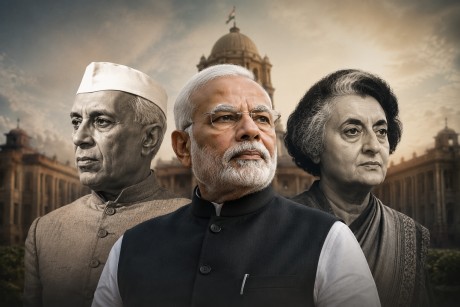
New Delhi, June 8, 2026 — As Prime Minister Narendra Modi approaches his 12th year in office, a pointed political commentary is making waves, placing his tenure under direct comparison with India’s two most consequential long-serving prime ministers — Jawaharlal Nehru and Indira Gandhi.
Political analyst Manish Anand, in a monologue for the YouTube channel of The Raisina Hills, delivered a sweeping assessment of all three leaders — and his verdict on Modi is notably mixed.
“Nehru’s legacy had one big stain — the 1962 war with China,” Anand said, adding: “But if you set that aside, his contribution to nation-building was enormous. He was an institution builder. The IITs, the educational establishments he created — the knowledge economy that emerged from those institutions is what powers Indian diaspora remittances today, which actually exceed annual foreign direct investment into the country.”
Anand acknowledged that Nehru led India through perhaps its most turbulent post-independence years — absorbing millions of Partition refugees, preserving democratic institutions, and defying Western predictions that India would fracture into pieces. “Several Western commentators at the time of independence believed India would not survive in its current form. Nehru proved them wrong. Democracy strengthened, Parliament strengthened, the legislature strengthened,” added Anand.
On Indira Gandhi, Anand credited her with transforming India’s food security landscape, nationalising banks to channel public sector investment, and — most dramatically — engineering the creation of Bangladesh in 1971. “She ignored multiple threats from the United States, supported the Mukti Bahini, and split Pakistan in two. That is a formidable legacy,” he stressed.
However, Anand was equally unsparing about her darker chapter. “She damaged democracy through the Emergency. The excesses that occurred, largely because she failed to rein in Sanjay Gandhi, are something the Congress party continues to pay for even today,” added the analyst.
Then came his assessment of Modi — and here, Anand’s tone shifted sharply.
“Modi is about to break Nehru’s record of the longest consecutive tenure as Prime Minister. In two more years, he will likely surpass Indira Gandhi’s roughly 14 years as well. He will be in the category of the three longest-serving prime ministers this country has ever had,” Anand noted. But longevity, he argued, does not equal legacy.
“Modi received a relatively strong economy when he came to power. He has the weakest opposition any Prime Minister in this country has ever faced. The media landscape has largely been quiet. These were conditions that neither Nehru nor Indira Gandhi enjoyed — and yet, the fundamental economic transformation that was both possible and necessary did not happen,” added Anand.
Anand pointed to India’s demographic dividend — with an average population age of just 28 — as a historic opportunity that, in his view, was not fully leveraged. “The revolution that should have come to the economy never quite arrived,” he said.
He also took aim at specific policy decisions. “Demonetisation caused enormous suffering to ordinary people. The COVID lockdown was announced in a manner that severely disrupted lives. The Kumbh Mela and other large gatherings were allowed to continue during the pandemic when they should not have been. Mandatory vaccination also remains a subject of significant debate — it should have been kept voluntary,” he added.
On unemployment and education, Anand pointed to youth protests at Jantar Mantar as a symptom of a deeper governance failure. “The crisis in the examination and education sector will be remembered as part of Modi’s legacy. Young people are standing to protest — that tells its own story,” he added.
His conclusion was stark. “Modi remained entangled in electoral politics for all 12 years — one state election after another, welfarism-driven economic policy, always campaign mode. The mandate people gave him was enormous. The opportunity was historic. But the opportunity, somewhere, was lost — and history will always remember that the people gave him a landslide, but the work that needed to be done was not done,” said Anand.
Modi had been Chief Minister of Gujarat since 2001 and Prime Minister since 2014 — over 25 years as a head of government, a record by any measure. Whether that record translates into transformational legacy, Anand suggests, is a question history will answer — but not kindly.
Surplus Without Sovereignty: Nehru’s Fears Return in Today’s India
Follow The Raisina Hills on WhatsApp, Instagram, YouTube, Facebook, and LinkedIn




