


By P. SESH KUMAR
From Sweden’s Royal Order of the Polar Star to the UNSC deadlock, India’s diplomatic ascent under Modi confronts the harder challenge of converting prestige into lasting structural power.
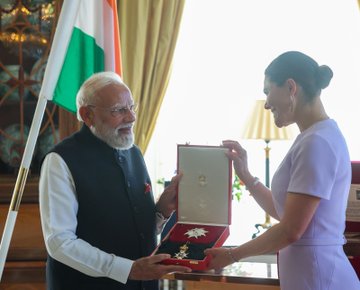
New Delhi, May 18, 2026 — When Sweden’s King Carl XVI Gustaf pinned the Royal Order of the Polar Star — an order established in 1748 with the ringing Latin motto Nescit Occasum (“It Knows No Decline”) —upon Prime Minister Narendra Modi’s chest in Gothenburg on May 17, 2026, he was doing more than completing a polite diplomatic ritual. He was placing the capstone on what is now a staggering collection of 31 international honours that no sitting head of government in the contemporary world has matched.
The Full Constellation: What 31 Awards Actually Represent
The roll-call of Modi’s international honours reads like a dispatch from a world that has decided, across every civilisational axis, to pay attention to India. The list — now officially recorded in a Parliamentary Annexure by the Ministry of External Affairs —begins in 2016 with Saudi Arabia’s Order of King Abdulaziz and ends, as of May 2026, with Sweden’s Royal Order of the Polar Star Commander Grand Cross. In between lies a breathtaking geographic sweep: the UAE’s Order of Zayed (2019), the United States’ Legion of Merit (2020), France’s Grand Cross of the Légion d’Honneur (2023), Russia’s Order of Saint Andrew the Apostle (2024), Egypt’s Order of the Nile (2023), Nigeria’s Grand Commander of the Order of the Niger (2024), Brazil’s Grand Collar of the National Order of the Southern Cross (2025), Mauritius’s Grand Commander of the Order of the Star and Key of the Indian Ocean (2025), Cyprus’s Grand Cross of the Order of Makarios III (2025), and Namibia’s Order of the Most Ancient Welwitschia Mirabilis (2025).
They are the highest civilian awards their respective countries possess — some reserved exclusively for foreign heads of state. Bhutan’s Order of the Druk Gyalpo, for instance, was awarded to Modi as the first foreign head of government ever to receive it — a distinction that speaks not to diplomatic politeness but to a deep and singular bilateral intimacy. Palestine bestowed its Grand Collar of the State of Palestine in 2018; India’s delicate positioning as a friend of both Palestine and Israel — the latter also conferring its highest honour-makes Modi the only world leader to hold both simultaneously. That is not symbolism. That is a geopolitical tightrope walked with remarkable dexterity.
The breadth of the Islamic world’s recognition deserves particular notice. Seven of Modi’s honours come from Muslim-majority nations — Saudi Arabia, UAE, Bahrain, Maldives, Palestine, Egypt, and Kuwait. For a leader routinely accused in some quarters of presiding over a government with fraught relations with its own Muslim minority, the fact that the custodians of the two holiest cities in Islam, the Maldives, and Egypt have all chosen to confer their supreme civilian distinctions speaks to a foreign policy architecture that has deliberately insulated bilateral relationships from domestic political noise. This is strategic clarity of a high order.
Comparing Modi’s Honours with His Global Contemporaries
The comparative context is essential and the numbers are telling. A widely cited analysis compares Modi’s honours tally with other major world leaders: Vladimir Putin has received approximately 15 international honours, Angela Merkel 18, Xi Jinping around 12, and Emmanuel Macron roughly 10. With 31, Modi outpaces every one of them by a considerable margin. This is not a case of India distributing largesse and receiving it in return — the countries conferring these awards range from the superpower United States to the tiny island of Dominica, from ancient European monarchies like Sweden (whose Polar Star Order dates to 1748, awarded by King Frederick I) to postcolonial African states conferring hard-won national symbols. The United Nations itself weighed in, conferring the prestigious Champion of the Earth Award in 2018 for environmental leadership-and the Seoul Peace Prize and the Bill and Melinda Gates Foundation’s Global Goalkeepers Award followed in 2019.
What makes this comparison meaningful rather than merely arithmetical is the geopolitical diversity of the award-givers. A leader who collects honours only from neighbours or strategic clients can be dismissed as running a regional patronage circuit. A leader whose honours come from the US, Russia, France, Saudi Arabia, Israel and Palestine, Nigeria, Brazil, and Sweden simultaneously is constructing a genuine all-azimuth diplomatic footprint. India’s multi-alignment strategy- engaging the US through the Quad while sitting in BRICS and the Shanghai Cooperation Organisation, while simultaneously championing the Global South- is being externally validated by the countries themselves participating in that architecture.
The Critic’s Argument: All Glitter, No Gold
Let the critics speak now, and let them speak fully, for they are not without substance. The most pointed version of the criticism runs thus: awards are diplomatic currency, given lavishly to grease bilateral wheels, build photo opportunities, and send signals to domestic audiences on both sides. The conferring government signals warmth toward India; India signals status to its own population. The medals go into a cabinet; the trade balances, defence deals, and multilateral votes remain largely unchanged. A Cato Institute commentary written in the wake of the 2023 G20 summit was brutally direct: “A guru is nothing without disciples… the notion of India as a Vishwaguru sounds like a bad joke in the West.”
This critique has force. Consider the data-points that awards cannot paper over. India ranked 130 out of 193 countries on the Human Development Index in 2023. India’s military expenditure in 2024 stood at USD 86 billion — far behind China’s USD 314 billion — limiting hard power projection capability significantly. India ranked 144th out of 196 countries in per capita GDP at market exchange rates. In the Brand Finance Global Soft Power Index 2025, India actually slipped one rank to 30th place with a score of 49.8 out of 100, lagging well behind not just the US and China but many European middle powers. The Lowy Institute’s Asia Power Index 2025, while upgrading India to “Major Power” status with a score of 40.0 — third in Asia behind the US (80.5) and China (73.7) —simultaneously flagged that India’s Power Gap score (the difference between the power it should wield given its resources and the power it actually wields) has expanded to its largest ever gap. India, in the language of power analysts, is a spectacular underperformer.
Then there is the Vishwaguru question. The concept — that India is the “teacher to the world” — is rooted in a long civilisational tradition stretching from Swami Vivekananda to Sri Aurobindo, and the Modi government weaponised it as a branding proposition, plastering it across New Delhi’s billboards during the G20 summit. The Lowy Institute’s analysis, published as recently as April 2026, is withering on this point: “Claims of civilisational superiority appear out of step” and the teacher-student metaphor “inadvertently reinforces hierarchies” that are precisely what the Global South does not want from a self-appointed champion. Smaller South Asian neighbours — Nepal, Bangladesh, Sri Lanka — have historically felt the weight of Indian paternalism; Vishwaguru can reinforce exactly that anxiety. Recognising this, Modi himself has gradually reduced his public use of the term in recent years, pivoting instead to the more collegial Vishwamitra — “friend of the world” — which his External Affairs Minister S. Jaishankar has championed as a posture of partnership rather than preachiness.
The criticism has even more bite when it reaches UN General Assembly voting records. India’s strategic autonomy — which is a genuine strength in many contexts — has also meant that on the Russia-Ukraine conflict, India abstained repeatedly, drawing sharp criticism from Western partners who have nonetheless continued conferring honours. U.S.-based South Asia expert Ashley Tellis argued pointedly in Foreign Affairs that Washington cannot count on Indian alignment on “significant strategic matters,” explicitly citing Ukraine as evidence. If one of the five veto-wielding UNSC members is quietly hedging on whether India is truly reliable, that has implications that no amount of Legion of Merit citations can resolve.
Modi exemplifies a post-globalization archetype: European Analyst
What India Has Actually Built: The Substance Behind the Sashes
And yet, to dismiss 31 honours as pure symbolism is to make the symmetrically opposite error —dismissing evidence because it is inconvenient. The honest reckoning demands acknowledging what India has materially constructed in the world over the past decade.
India’s Vaccine Maitri programme supplied COVID-19 vaccines to over 100 countries during the pandemic, earning genuine gratitude that was not manufactured by diplomatic convenience. The Caribbean nations- Dominica, Guyana, Barbados, Trinidad and Tobago — that conferred honours on Modi are among the countries that received Indian vaccines when the Western world was hoarding doses. India’s digital public infrastructure — the Unified Payments Interface, Aadhaar, DigiLocker — is being exported to Sri Lanka, Mauritius, Nepal, and several African nations, earning India a reputation as the architect of a practical development model for the Global South. As the “Pharmacy of the World,” Indian generic pharmaceutical companies supply life-saving medicines to low-income countries at a fraction of global prices. India’s 35 million-strong diaspora-the largest in the world- generates remittances exceeding USD 125 billion annually and has placed Indian-origin leaders at the helm of major economies including the United Kingdom, Ireland, and Suriname.
India’s G20 presidency in 2023 was a genuine diplomatic landmark. Under Modi’s stewardship, India secured 100 per cent consensus on the New Delhi Declaration — an achievement many had written off as impossible given geopolitical fractures over Ukraine. More significantly, India secured the historic inclusion of the African Union as a permanent G20 member-arguably the most consequential institutional reform of the G20 in decades, and a direct outcome of India’s positioning as the voice of the Global South. The G20 presidency also advanced India’s Digital Public Infrastructure model as a global blueprint, endorsed through the G20 framework. This is not ceremony. This is structural influence in action.
Operation Sindoor in May 2025 —India’s decisive cross-border precision strikes against terrorist infrastructure in Pakistan-occupied Kashmir and deep inside Pakistan, in response to the Pahalgam terror attack — was a watershed moment in the country’s strategic posture. The operation signalled a clear departure from India’s historically reactive counter-terrorism approach, projecting hard power with calibrated precision and demonstrating that India is now willing to define and enforce its own red lines regardless of international hand-wringing. The Carnegie Endowment’s post-operation analysis identified key military lessons that are now being studied by strategic establishments globally. This is the kind of hard power demonstration that changes how countries calculate in their bilateral dealings with India —far more than any award ceremony.
On the economic front, India’s trajectory, whatever the momentary fluctuations in annual nominal dollar rankings caused by currency movements, is structurally powerful: the world’s fastest-growing major economy at 6.48 per cent in 2026, with a nominal GDP of USD 4.15 trillion ranked sixth globally, and IMF projections pointing to overtaking Japan and Germany to become the world’s third-largest economy by early 2030. In purchasing power parity terms — the more economically meaningful comparison — India’s GDP of USD 18.90 trillion already places it third in the world, behind only the US and China.
The UN Security Council: India’s Unfinished Business
Nowhere is the gap between India’s diplomatic popularity and its structural power more brutally illustrated than in the ongoing saga of UNSC reform. Four of the five permanent members — the United States, United Kingdom, France, and Russia — have all bilaterally expressed support for India’s permanent membership. The G4 grouping of India, Brazil, Germany, and Japan, formed in 2004, has presented an elaborately worked-out reform model in Intergovernmental Negotiations at the UN, proposing expansion from 15 to 25-26 seats with six new permanent members- two from Africa, two from Asia-Pacific, one from Latin America, and one from Western Europe. In January 2026, the G4 nations proposed “early action” on UNSC restructuring, with India’s Permanent Representative warning that delay “will cause more human suffering and misery.”
And yet the whole architecture sits frozen. China — the single holdout — has adopted its signature approach of offering impeccably worded non-commitments. In February 2026, Beijing said it “understands and respects” India’s aspirations but stopped conspicuously short of the one word that would matter: support. China’s calculus is transparent: it is the only Asian power with permanent UNSC membership, and admitting India would dilute that unique status precisely as bilateral competition in the Indo-Pacific, the Himalayas, and the Indian Ocean intensifies. Beijing has additionally floated the poisoned-apple suggestion that it might back India provided New Delhi abandons Japan’s bid-knowing full well that fracturing the G4 is something India will not do.
The obstacles, however, go beyond Chinese obstruction. The Uniting for Consensus bloc — led by Italy, and including Pakistan, Canada, Mexico, Spain, South Korea, and Turkey —opposes permanent seats for anyone, preferring more elected non-permanent members. The US, despite rhetorical support, has been historically cautious about actually extending veto power to new members — former Under Secretary of State Nicholas Burns stated as far back as 2008: “We want to preserve the veto, and we do not want to extend a veto to new permanent members.” Western concerns about India’s strategic autonomy on issues like Ukraine add a subtle but real qualification to even ostensibly friendly declarations. UNSC reform requires two-thirds approval from all UN member states plus ratification- and crucially, it requires no veto from any P5 member. China’s position makes the arithmetic currently impossible.
In a creative gambit as of April 2026, India and the G4 have proposed a 15-year veto deferral — accepting a permanent seat while voluntarily putting the veto power “on ice” for a decade and a half, thereby calling the bluff of P5 nations who claim their objection is to the proliferation of veto rights rather than to Indian membership itself. This is sophisticated, strategically patient multilateralism. Whether it breaks the logjam depends entirely on whether China’s objection is truly about veto proliferation or fundamentally about India’s rise — and the honest answer to that question is rather obvious.
What India Must Actually Do: From Ceremony to Structural Power
The awards are real. The recognition is genuine. The goodwill is bankable. But goodwill in geopolitics is a wasting asset unless converted into structural weight. Here is the possible unsentimental agenda- which, the Government would also be acutely aware of.
Harden the Hard Power. India’s military expenditure at USD 86 billion versus China’s USD 314 billion is not a gap that awards can bridge. India remains one of the world’s largest arms importers, accounting for 9.5 per cent of global arms imports between 2016 and 2020. A country that cannot build its own advanced fighter aircraft, submarine systems, and semiconductor fabs cannot claim permanent veto power at the high table on civilisational pride alone. Atmanirbharta — the self-reliance programme — must deliver industrial-military capability, not merely a rebranding of imported weapons.
Close the Human Development Deficit. At rank 130 of 193 on the Human Development Index, India’s human capital story undercuts its great power narrative at every turn. A country cannot be a Vishwamitra to the world’s poorest if millions of its own citizens lack basic nutrition, sanitation, and quality education. Every honour received amplifies the expectation of commensurate domestic achievement. The asymmetry between India’s international recognition and its per capita income of USD 2,813 — against Germany’s USD 65,303 or the UK’s USD 61,056 — is a vulnerability that no diplomatic alchemy can permanently conceal.
Consolidate the Regional Neighbourhood. India exerts less influence in its immediate region than its size demands — and this is the single most important credibility deficit in its UNSC bid. Forgetting Pakistan for a moment and our obsession with it, Bangladesh’s political reorientation, Nepal’s oscillations toward China, Sri Lanka’s debt diplomacy vulnerability, and the Maldives’ periodic flirtations with Beijing are not footnotes to India’s rise — they are the exam it keeps failing. A power that cannot anchor its own neighbourhood cannot credibly claim to anchor global peace.
Institutionalise the Global South Leadership. The Vaccine Maitri initiative, the Digital Public Infrastructure exports, the G20-African Union inclusion-these are genuinely transformative, but they need institutional architecture to consolidate. India should be pushing for a permanent Global South secretariat, ideally housed in India, to convert its G20 diplomatic momentum into a standing institutional presence that speaks for developing nations in international fora year-round, not just during summit season.
Exploit the China Containment Opportunity. China’s intransigence on the UNSC- combined with its Belt and Road overreach, its debt-trap diplomacy in the Pacific and Africa, and its increasingly aggressive posture in the South China Sea- is gifting India a window of opportunity that may not remain open indefinitely. Many of the very nations conferring awards on Modi are simultaneously anxious about Chinese dependency. Nigeria, Brazil, Mauritius, Sri Lanka, Trinidad and Tobago — these are not naive recipients of Indian diplomatic charm; they are sovereigns making strategic hedging calculations. India must offer them a credible alternative architecture: trade, investment, technology, and security partnerships, not just vaccine supplies and warm speeches.
Make the Veto Deferral Proposal Unstoppable. The G4’s 15-year veto deferral proposal is politically brilliant. India should now launch a diplomatic blitz to build a supermajority in the UN General Assembly around this proposal-making China’s obstruction the story rather than UNSC reform’s complexity. If Beijing is the sole obstacle to a 25-seat Security Council that better represents Asia, Africa, and Latin America, the framing becomes vastly more powerful. India has 31 nations- including France, Russia, and the US- who have formally decorated its Prime Minister with their highest honours. It is time to redeem those honours at the ballot box of the General Assembly.
The Verdict: Not a Myth, Not Yet a Fact-But Becoming Both at Once
The Vishwaguru branding, taken literally, is indeed overreach. India is not the world’s teacher. No nation in the twenty-first century gets to play headmaster to 8 billion people. But the pivot to Vishwamitra- the friend of the world- is not mere rebranding; it reflects a genuine maturation of Indian foreign policy thinking. The question of whether India “matters” in the world of power politics is no longer seriously debatable. The third-ranked major power in Asia by comprehensive score, the world’s fastest-growing major economy, a nuclear-armed state with demonstrated precision strike capability, the host of 35 million ambassadors of soft power in every corner of the globe-India is inescapably consequential.
What remains unresolved — and what the 31 awards, for all their glittering reality, cannot by themselves resolve — is the conversion problem: translating recognised importance into structural institutional weight. The Lowy Institute’s Power Gap finding that India “exerts less influence than expected given its available resources” is the definitive diagnosis. The awards are the world’s way of saying: we see you, we want you at the table. India’s task, urgent and unfinished, is to make itself so indispensable- economically, militarily, institutionally, and in human capital terms- that the question of a permanent UNSC seat answers itself by the sheer force of gravity, with or without Beijing’s blessing.
When Sweden’s order carries the motto Nescit Occasum- “It Knows No Decline” — one is tempted to read it as an accidental prophecy about India itself. A civilisation that has survived millennia of conquest and reinvention is not going to be permanently denied a seat it has already earned in the court of global opinion. The only question is whether the institutional architecture catches up with the diplomatic reality- and whether India has the strategic patience and domestic discipline to make it happen.
(This is an opinion piece. Views expressed are the author’s own.)
Follow The Raisina Hills on WhatsApp, Instagram, YouTube, Facebook, and LinkedIn




