


Experts say India’s Mission 2047 Growth Strategy needs cross-party consensus, state-level reforms and deeper global integration to break the 6.5% ceiling.
By TRH Economy Desk
New Delhi, February 20, 2026 — As India charts its path towards becoming a developed nation by 2047, policy leaders and industry experts gathered in the capital to debate what must change beyond annual budget arithmetic.
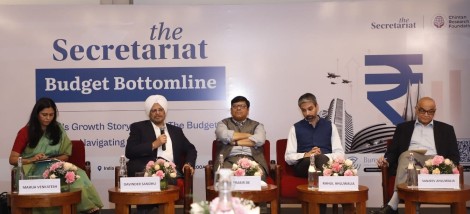
The Secretariat, in collaboration with the Chintan Research Foundation (CRF), hosted a high-level policy dialogue titled “India’s Growth Story Beyond The Budget: Navigating Mission 2047” at India Habitat Centre on February 18.
Experts warned that without long-term structural reform and cross-party policy continuity, India risks remaining stuck at a 6.5% growth plateau.
Stuck at 6.5%?
Davinder Sandhu, Chairman of Primus Partners, delivered a blunt assessment: “We’ve reached a plateau, and that plateau is 6.5%.” According to him, future acceleration will not come merely from macroeconomic tweaks or fiscal fine-tuning.
Instead, he called for a 25-year cross-party consensus to anchor the Mission 2047 Growth Strategy. Without long-term policy stability, he cautioned, investors will remain hesitant. He also flagged widening regional and intra-state inequality as a serious threat to social cohesion and investment momentum. “Inequality stares us in the face,” he said.
Growth Must Converge Across States
Prabir De, Professor at RIS, argued that India’s long-term trajectory hinges on deeper integration into global value chains. Export expansion, not inward focus, will determine competitiveness in an increasingly fragmented global order.
He warned that growth cannot remain Delhi-centric. States must converge in capacity and competitiveness to build what he termed “Viksit Rajya” (developed states), without which the 2047 vision risks remaining aspirational rhetoric.
The Market Myth
Rahul Ahluwalia, Founder-Director of the Foundation for Economic Development, challenged the assumption that India’s large population automatically translates into market depth.
“We are a big market only because we have 1.4 billion people. On a per capita basis, we are one of the smallest markets in the world,” he observed. He added that inclusive growth is not charity but strategy: “Truly inclusive growth is faster growth.”
Sanjeev Ahluwalia, Distinguished Fellow at CRF, emphasised MSME flexibility, shared responsibility, and political willingness to accept tough trade-offs as essential ingredients for sustained momentum.
Economics Is Now Geopolitics
The second session broadened the lens. Former Ambassador Bala Bhaskar argued that economics today is shaped by sanctions, tariff wars and the weaponisation of the dollar. He identified 2012 as a turning point — citing the US shale revolution, China’s high-tech pivot, and shifting manufacturing geographies. Artificial Intelligence, he added, could permanently reshape global production patterns.
Vaibhav Dange, CEO of Build India Foundation, stressed that India’s resilience during the pandemic and geopolitical disruptions rested heavily on infrastructure capacity — a pillar that must now scale faster.
Bidisha Bhattacharya of CRF called for a transition “from volume to value” in exports. Moving up the economic complexity ladder — from commodities to pharmaceuticals, engineered goods and electronics — would strengthen production ecosystems and employment resilience.
Beyond Budgets
The consensus was clear: Mission 2047 cannot be achieved through annual budget recalibrations alone. Structural reform, state-level competitiveness, export sophistication and geopolitical agility will define whether India merely grows — or truly transforms.
Follow The Raisina Hills on WhatsApp, Instagram, YouTube, Facebook, and LinkedIn




