


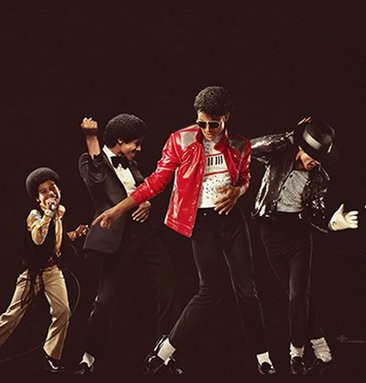
Jaafar Jackson dazzles as the King of Pop, but a sanitized script keeps the biopic from confronting the man behind the legend
By TRH Features Desk
April 21, 2026 — Michael, directed by Antoine Fuqua, arrives in theatres this week under the weight of reshoots, legal complications, and enormous expectations. It leaves early critics sharply divided, carrying a low Rotten Tomatoes score of 26%. Yet, the film is far from a simple misfire. Anchored by a remarkable central performance from Jaafar Jackson, it delivers moments of genuine electricity even as it struggles under the constraints of its own design.
At its core, Michael is a deliberately limited portrait. The narrative traces Michael Jackson from his childhood in the Jackson 5 to December 9, 1984 — the final night of the Victory Tour. What it omits is just as significant: the abuse allegations, the Neverland years, the media frenzy, and the legal battles are entirely absent. Even Janet Jackson is missing. This is no accident. With multiple Jackson family members serving as executive producers and Jaafar Jackson — Michael’s nephew — in the lead, the film exists firmly within the family’s approved narrative.
That context defines both its strengths and its limitations.
The strongest case for Michael begins and ends with Jaafar Jackson. At 28, he does more than resemble his uncle — he channels him with uncanny precision. From the moonwalk to the distinctive vocal tone and physical expressiveness, his performance captures the blend of fragility and control that defined Michael Jackson’s stage presence. Critics across the board, including Variety’s Owen Gleiberman, have acknowledged the authenticity of his portrayal. In performance sequences — particularly those recreating the Jackson 5 era and the Thriller period — the film comes alive. Fuqua’s strength in staging spectacle is evident, and these moments deliver the kind of immersive musical experience audiences expect.
The supporting cast adds weight, if not depth. Colman Domingo brings intensity to the role of Joe Jackson, while Nia Long lends warmth as Katherine Jackson. Miles Teller and Kendrick Sampson round out the ensemble competently. Yet, these performances operate within a framework that rarely allows complexity to surface.
That is where the film falters. Critics have widely pointed to its sanitized approach. Writing in The Hollywood Reporter, David Rooney notes that while the film captures an undercurrent of melancholy beneath the superstardom, its refusal to engage with the most controversial aspects of Jackson’s life significantly limits its impact. Others are less forgiving. Reviews have described it as overly polished and emotionally evasive — more interested in preserving an image than interrogating a life.
Comparisons to Bohemian Rhapsody are inevitable. Like that film, Michael follows a familiar, crowd-pleasing structure while avoiding deeper, more uncomfortable truths. Critics argue that this approach reduces a complex figure into a curated highlight reel. The absence of conflict diminishes the stakes, leaving the narrative feeling incomplete.
Structurally, the decision to end the story in 1984 proves to be a critical weakness. Biographical storytelling depends on consequence — on showing not just the ascent, but the cost. By stopping before the most turbulent chapters of Jackson’s life, the film avoids reckoning altogether. What remains is a portrayal that excels in performance but struggles in introspection.
Fuqua’s direction often leans toward reverence, framing Jackson as an almost mythic figure. Extended shots of awestruck audiences reinforce his cultural impact, but they also contribute to a sense that the film is observing from a distance rather than engaging deeply. Moments hinting at loneliness and isolation are present but underdeveloped, never fully explored.
Audience reactions may diverge from critical opinion. The film is clearly designed for fans, and its musical sequences — combined with Jaafar Jackson’s performance — are likely to resonate strongly. Early responses suggest a split: admiration for the central portrayal alongside frustration with the film’s cautious storytelling.
Ultimately, Michael is a film caught between tribute and biography. It offers glimpses of brilliance — a compelling lead performance and powerful musical recreations — but remains constrained by its unwillingness to confront the full scope of its subject’s life. It is not the outright failure some reviews suggest, but neither is it the definitive portrait of Michael Jackson that audiences might have hoped for.
Film Review: Warfare – A Brutal, Immersive Descent into Combat
Follow The Raisina Hills on WhatsApp, Instagram, YouTube, Facebook, and LinkedIn




