


From Mahanagar’s Arati to Mamata Banerjee, Bengal’s story is one of struggle and transformation. But the 2026 verdict signals a new shift in Kolkata’s political landscape.
By NIRENDRA DEV
Kolkata, May 4, 2026 — Mahanagar is a Satyajit Ray masterpiece. As the name suggests — Big City — the film portrays contradictions of a metro life and multiple challenges.
In an age of development, the past/old and the tradition struggle to survive amongst the superficial morals of the middleclass.
As industry and trade take over the city, the morality which Hindu Bengalis upper caste families try to uphold onto quite tightly crumble, while they are reshaped as well. In a political sense, that is a struggle that the then Calcutta and today’s Kolkata is still undergoing.
During Buddhadeb era, Mamata Banerjee symbolised a new kind of protest — linking the use of land for agriculture and not industries. This had touched an emotive chord.
The film tells the story of a housewife. Yet Mamata Banerjee, who has remained unmarried throughout her life, mirrors many of the struggles faced by the film’s protagonist, Arati, as outgoing chief minister. On the vote counting day, May 4th, the BJP has turned the table.
From 14 in 2021 to 54 seats in Bengal’s Presidency region, the lotus party has flipped the script in Kolkata and surrounding areas and extended its reach beyond the tea garden districts.
The film Mahanagar was made in the 1960s—an era very different from today. Through years dominated first by the Congress and then the Left, Mamata Banerjee climbed the political ladder the hard way, without the advantages of privilege or legacy. The film’s protagonist, a faceless housewife, embodies a quiet struggle—dutiful, resilient, managing her home while accepting life as it unfolds.
But when a crisis strikes and the cost of living rises sharply, she finds her courage and turns into a rebel.
The politician Mamata Banerjee has long been defined by her rebellious streak—one she has consistently turned into political strength. She faced physical aggression from Left cadres and confrontations with the police yet remained defiant. Her combative style was equally visible in Parliament: she protested against then Speaker Shivraj Patil in 1995, and in 2004 famously hurled bangles at Speaker Somnath Chatterjee after being denied the opportunity to raise the issue of Bangladeshi infiltration.
The paradox in 2026 is striking: Mamata Banerjee opposed SIR, yet by then her image had also come to be seen as sympathetic to infiltrators. The issue of Bangladeshi infiltration, in fact, played a significant role in her political setback.
In the film Mahanagar, Arati resigns from her job in a moment of rage. In unemployment, she and her husband become “equal.” But is that truly a reflection of metropolitan growth and prosperity?
In politics, the context is far more complex. There is no shortage of “rage” in Mamata—but perhaps it has often been misdirected. If Arati could not endure her workplace, Mamata now faces a different reality: a loss of public confidence that may compel her to step aside.
Born on January 5, 1955, in Kolkata, Mamata began her political journey in the 1970s and rose swiftly within the Congress ranks. She later served as a Union Minister under both P. V. Narasimha Rao and Atal Bihari Vajpayee. In 1984, she defeated Somnath Chatterjee, though she lost the seat in 1989 to CPI(M)’s Malini Bhattacharya.
Known for constantly shifting constituencies, she faced a major setback in 2021 when she lost Nandigram. This year, she is locked in a close contest in Bhabaninagar—leading overall, though at one point she had trailed, underlining the volatility of her political journey.
In the Kolkata region, the BJP showed strength in constituencies like Bidhannagar and Rashbehari, where journalist Swapan Dasgupta entered the fray.
Mamata Banerjee will always be remembered for achieving the unthinkable—the ouster of the Left Front in 2011, ending decades of communist rule in West Bengal.
What makes the film Mahanagar revolutionary? Arati’s husband, played by Anil Chatterjee, declares that “a woman’s place is in the home.” Yet the film quietly dismantles that notion. Mamata, too, faced ridicule and resistance from Left circles, but in both stories—the politician’s and the one on the silver screen—the resilience of the human spirit ultimately prevails.
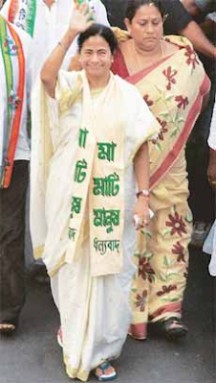
For over 15 years, Mamata’s political appeal rested on the three Ms—maa, maati, manush. However, the high-stakes 2026 election saw four different Ms shaping the contest: Muslim voters, mahila (women), migrants, and the Matua (Hindu) community.
At the same time, the influence of two towering figures—Narendra Modi and Mamata herself—proved decisive in determining the outcome. During the campaign, Modi sharpened his attack, alleging that the TMC had made maa unsafe, allowed maati to be accessed by Bangladeshi infiltrators, and forced manush—the people of West Bengal—to migrate in search of livelihood.
Follow The Raisina Hills on WhatsApp, Instagram, YouTube, Facebook, and LinkedIn




