


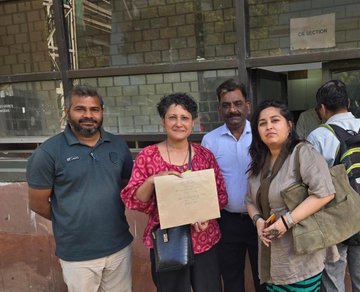
In one of the most coordinated displays of press solidarity in recent years, six major journalist organisations convened at the Press Club of India in New Delhi on Saturday to demand the complete withdrawal of the draft Information Technology (Intermediary Guidelines and Digital Media Ethics Code) Second Amendment Rules, 2026.
By TRH News Desk
New Delhi, April 11, 2026 — The joint meeting — bringing together the Press Club of India (PCI), DIGIPUB, Editors’ Guild of India, Indian Women’s Press Corp, Network of Women in Media, and Delhi Union of Journalists — adopted eight resolutions that collectively reject the Ministry of Electronics and Information Technology’s (MeitY) proposed amendments as a structured architecture for censorship.
The Core Threat: Executive Overreach
Speakers at the meeting repeatedly flagged Rule 3(4) of the Draft IT Rules 2026, which grants the Executive extraordinary and largely unchecked powers to censor digital content. Several journalists cited existing instances of arbitrary takedowns and platform shutdowns already hampering their right to work — warning that the new amendments would formalise and dramatically expand this power without adequate judicial oversight or procedural accountability.
The resolutions demand that MeitY withdraw the draft amendments in totality, that the government strictly follow procedural safeguards laid down under Section 69A of the Information Technology Act, 2000 — as upheld by the Supreme Court in the landmark Shreya Singhal vs Union of India judgment — and that all delegated powers under Section 69A granted to various agencies, which have bypassed these safeguards, be immediately recalled.
The February 2026 Rollback Demand
A particularly urgent resolution targets the February 2026 amendment to the IT Rules 2021, which compressed the timeline for intermediaries to take down content from 36 hours to just three hours. The meeting declared this executive diktat borders on contempt of the Supreme Court, which had specifically read down Section 79 to strengthen safe harbour protections in the Shreya Singhal ruling.
The bodies also demanded the immediate halting of the Sahyog portal — described as operating without any legislative sanction and in complete violation of procedural safeguards under Section 79A of the IT Act — and the withdrawal of Rule 16 of the IT Rules 2009, which permits blocking of speech without any accountability mechanism.
Freelancers and Creators: The Most Vulnerable
The meeting drew particular attention to independent journalists, solo podcasters, newsletter writers, and YouTube creators — those operating without institutional backing. For them, the compliance burden of the draft IT Rules 2026 is not merely regulatory friction; it is described as financially terminal. Beyond cost, the rules create a documented “chilling effect,” where creators may self-censor simply to avoid the risk of algorithmic misidentification and punitive takedowns.
The six bodies resolved to jointly intensify their campaign — including directly canvassing Members of Parliament — and demanded that the Government of India mandatorily consult all journalist stakeholders before drafting any legislation that curtails press freedom under Article 19(1)(a) of the Constitution, with such consultation beginning before draft legislation is published, not as a post-facto formality.
The message from the Press Club was unambiguous: India’s press freedom community is no longer responding to each rule individually. It is building a unified front.
FAQ
Q: What are the Draft IT Rules 2026 and why are journalists opposing them?
The Draft Information Technology (Intermediary Guidelines and Digital Media Ethics Code) Second Amendment Rules, 2026 expand executive powers to censor digital content under Rule 3(4), reduce takedown compliance windows from 36 hours to 3 hours, and impose financially prohibitive compliance frameworks on independent creators — prompting six major journalist bodies to demand their complete withdrawal.
Q: Which journalist bodies met at Press Club of India against IT Rules 2026?
The joint meeting included the Press Club of India (PCI), DIGIPUB, Editors’ Guild of India, Indian Women’s Press Corp, Network of Women in Media, and Delhi Union of Journalists.
Q: What is the Sahyog portal and why is it controversial?
The Sahyog portal is a government content-blocking mechanism that journalist bodies say operates without any legislative sanction and in complete violation of procedural safeguards under Section 79A of the IT Act 2000, making its operation legally questionable.
Q: How do the Draft IT Rules 2026 affect freelancers and independent creators?
The compliance framework of the Draft IT Rules 2026 imposes costs and obligations that are described as financially terminal for solo podcasters, newsletter writers, and YouTube creators, while also creating a chilling effect that may push creators toward self-censorship to avoid algorithmic misidentification and punitive takedowns.
Follow The Raisina Hills on WhatsApp, Instagram, YouTube, Facebook, and LinkedIn




