


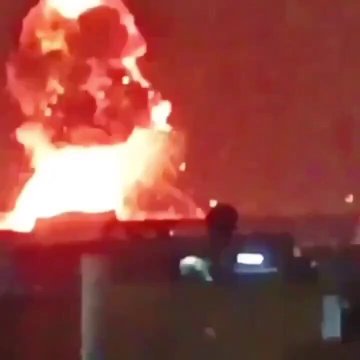
Iran’s ballistic attack on Qatar’s Ras Laffan complex destroyed infrastructure built at $70 billion that taps a gas reservoir holding 40% of the world’s largest-field reserves — and it’s only 10% depleted
By TRH World Desk
New Delhi, March 19, 2026 — Iran launched ballistic missiles at Ras Laffan Industrial City, Qatar’s sprawling LNG export hub, causing what QatarEnergy described as “extensive damage” in the most consequential energy infrastructure attack in modern history. Emergency response teams were deployed immediately. No casualties have been reported.
Brent crude closed at $111 a barrel. Analysts warn the number has further to run.
The strike was retaliation for an Israeli attack on Iran’s South Pars gas field — the world’s largest natural gas reservoir by a commanding margin, stretching 9,700 square kilometres across the Qatar–Iran maritime border. Ras Laffan draws from the same reservoir. Both sides have now destroyed each other’s surface infrastructure above it.
The scale of the loss is difficult to overstate. Ras Laffan alone supplied roughly 20% of the world’s liquefied natural gas. The complex cost $70 billion to build over two decades. Experts say restoring it to full capacity could take ten years — if the geopolitical conditions to do so ever return. The South Pars–North Dome reservoir holds approximately 40% of the combined recoverable reserves of the world’s 25 largest gas fields, and is nearly six times larger than the second biggest. Critically, it is only 10% depleted. The destruction of surface infrastructure on both sides effectively puts 90% of that reserve beyond reach for a generation.
“From a global energy supply perspective, we’re deep into worst-case scenario territory,” said analyst Arnaud Bertrand. Theresa Fallon of the Chicago Council called it “a significant escalation” whose economic effects “will likely be felt for years.”
The strike lands against an already fragile backdrop. The Strait of Hormuz — through which roughly 25% of the world’s seaborne oil and LNG passes — remains closed. The US is reported to be considering deploying ground troops to the region, with a defence supplemental of up to $200 billion under discussion in Washington. An American aircraft carrier is currently sidelined for repairs.
Rupee Rout: India’s Economy Faces Its Worst Storm in a Decade
Follow The Raisina Hills on WhatsApp, Instagram, YouTube, Facebook, and LinkedIn




