


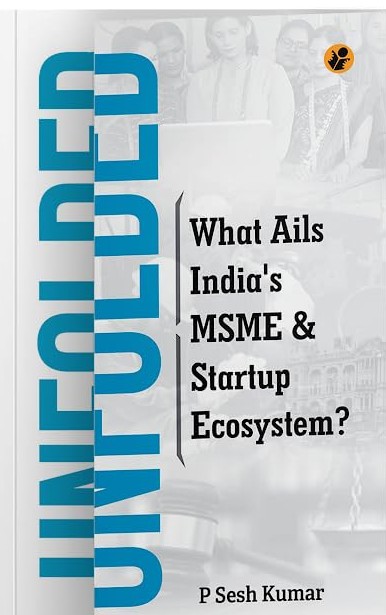
A new book argues that schemes have multiplied, but institutions haven’t matured—leaving MSMEs stuck between optimism and exhaustion.
By ABHISHEK MISHRA
Lucknow, February 1, 2026 — India does not have an MSME policy deficit; it has an MSME governance deficit. Over the years, successive governments have produced an expanding architecture of schemes, portals, incentives, and announcements aimed at small enterprises. Yet outcomes remain stubbornly modest.
When policy volume increases without proportional gains in access to credit, ease of operation, or resilience to shocks, the issue is no longer intent—it is institutional capacity. Unfolded: What Ails India’s MSME and Startup Ecosystem? by P. Sesh Kumar is a timely examination of this gap between prescription and execution. The book’s strength lies in its refusal to individualise failure.
MSMEs are not underperforming because entrepreneurs lack effort or imagination. They struggle because the systems designed to support them are fragmented, misaligned, and insufficiently accountable.
Kumar’s argument is not polemical; it is structural. Hе shows how policy density, when combined with weak execution, produces friction rather than support. At the centre of the book is a reframing that policymakers often acknowledge rhetorically but rarely operationalise.
MSMEs are not marginal actors or residual beneficiaries of welfare-style interventions. They are where jobs begin, where families move out of poverty, and where economic aspiration becomes tangible.
Yet these same enterprises encounter delayed credit, uneven enforcement, and compliance requirements that assume scale and capabilities they do not possess. The resulting condition—simultaneous optimism and exhaustion—is systemic.
The book repeatedly returns to a simple but uncomfortable truth: policy design, however sophisticated, cannot substitute for execution muscle. Large programmes attract attention; small, well-calibrated interventions reduce friction.
Across chapters, patterns emerge with consistency—fragile access to finance, asymmetry of power between lender and borrower, and a compliance regime that weighs heaviest on the smallest firms. Official reports appear orderly; lived experience is often disorderly.
Data comforts institutions more than it assists enterprises. One of the book’s early contributions is its insistence that definitions are consequential. How enterprises are classified determines who is seen and who remains invisible. Processes intended to formalise often become barriers to participation.
Forward linkages—between finance, markets, skills, and technology—remain weakly institutionalised. When process becomes the problem, additional schemes merely add layers to dysfunction. The comparative sections sharpen this diagnosis.
Drawing on experiences from Europe, East Asia, and targeted industrial strategies elsewhere, Kumar demonstrates that successful MSME ecosystems are built on coordination rather than accumulation. Skill development aligns with labour demand. Credit systems reflect enterprise risk rather than balance-sheet comfort. Regulation is predictable.
India’s challenge, by contrast, is fragmentation. Reforms exist, but they operate in silos. Capacity at the grassroots is uneven. Monitoring is frequent; evaluation is shallow.
What is required is not another initiative, but a whole-of-government approach. The discussion of India’s startup ecosystem is notably unsentimental. Economic growth today rests on two structurally different pillars: MSMEs and startups. Yet policy has struggled to harmonise the energy of startups with the resilience of MSMEs.
Ambition has often outpaced governance. Regulatory gaps, unchecked valuations, and delayed enforcement have created fragility beneath apparent success. The warning here is clear: when growth narratives outrun institutional maturity, correction is inevitable. Examples of unfulfilled commitments and fragile business models are presented not as moral failings, but as governance failures.
The startup ecosystem emerges as a paradox—genuine innovation alongside persistent friction. Bureaucratic delays, infrastructure gaps, talent shortages, and legal inefficiencies coexist with digital adoption, investor interest, and visible success stories. Policy, the book argues, must be designed for this complexity, not for selective celebration.
The section on firms seeking to return to India is particularly revealing. Redomiciliation reflects growing confidence in domestic capital markets, but it also exposes regulatory misalignment. Taxation structures, merger rules, and approval processes remain cumbersome.
Regulating the Healers: The Crisis of Medical Education in India
Confidence alone does not remove friction. Institutional reform must follow. Where Unfolded: What Ails India’s MSME and Startup Ecosystem? is most incisive is in its treatment of data and public finance. MSME numbers often mislead-not necessarily by intent, but by structure. Weak data infrastructure, poor estimation of credit gaps, and chronic delays in payments distort assessment.
Kumar’s prescriptions are pragmatic: unified identifiers, credible databases, early recognition of distress, and digital infrastructure that supports enterprise rather than merely tracking it. This critique resonates strongly in the context of the Union Budget presented this year. Once again, MSMEs are positioned at the centre of India’s growth narrative.
Budgets function simultaneously as moral compass, political manifesto, and economic GPS. They signal priorities and capture the spirit of their time. What Unfolded: What Ails India’s MSME and Startup Ecosystem? reminds us is that budgets set direction; institutions determine arrival.
The chapters examining public bodies and digital platforms extend this argument. Institutions rarely fail dramatically; they drift. Tokenism replaces transformation. Self -certification substitutes for scrutiny. Digitisation produces dashboards without outcomes. Kumar’s critique is restrained rather than rhetorical.
Accountability, he argues, must be restored through independent monitoring and institutional willingness to confront uncomfortable evidence.
The latter sections situate India’s MSMEs within a volatile global environment. Trade disruptions, tariff shocks, and geopolitical uncertainty affect small firms disproportionately. Large corporations diversify; MSMEs operate on thin margins and narrow markets. These are economic storms not of their making, yet they bear the cost. Resilience cannot be individualised. It must be holistic.
Unfolded: What Ails India’s MSME and Startup Ecosystem? fits squarely within the thematic arc of P. Sesh Kumar’s earlier work on audit, accountability, and institutional integrity. Across his writing, the concern is consistent: systems erode when scrutiny weakens and feedback is ignored.
This book extends that institutional lens to the MSME sector without forcing analogy. The continuity is evident and strengthens the argument. He finally returns to unfinished potential.
Despite repeated shocks—policy disruptions, demonetisation, the pandemic—India’s small enterprises persist. They are the country’s quiet revolutionaries: manufacturers, women entrepreneurs, artisans, technologists, innovators. The risk, Kumar warns, is an ecosystem distracted by optics—fundraising over fundamentals, compliance over capability. The book closes with a metaphor worth retaining. India need not be a maze-confusing, exhausting, and exclusionary. It can be a runway: clear, predictable, and designed for take-off. That is the challenge Unfolded: What Ails India’s MSME and Startup Ecosystem? places before policymakers and institutions. Not more schemes. Not louder optimism. But institutional truth, coherence, and courage.
If India wants its MSMEs to fly, it must first build the runway.
(Author has done MPhil Management from University of Cambridge, UK – MIT, USA, PhD in Strategy & Marketing from University of Cambridge, UK – MIT, USA, Leaders in Development Program, KSG, Harvard University (USA). He was a Cabinet Minister in UP Govt.)
Mark Tully: The BBC’s ‘Voice of India’ and a Journalism Icon
Follow The Raisina Hills on WhatsApp, Instagram, YouTube, Facebook, and LinkedIn




