


By TRH World Desk
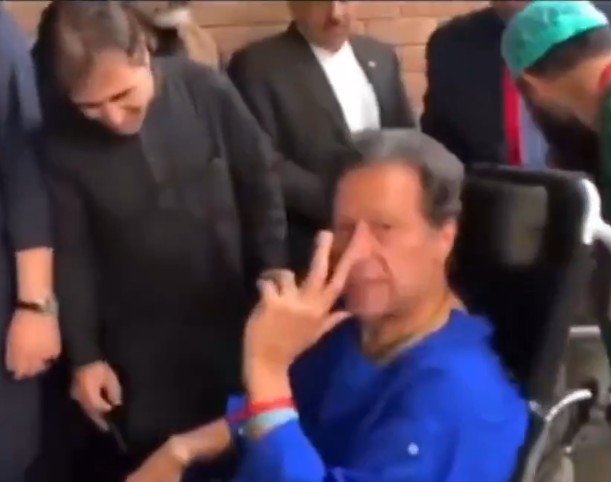
Imran Khan was seen — barely — for the first time in months, moved under heavy guard to an Islamabad hospital and back to prison by court order. What the brief sighting, and quiet signals toward the military, could mean for Pakistan’s politics.
New Delhi, August 22, 2026 — For months, Imran Khan existed mostly as a rumour: a jailed former prime minister whose family said he was going blind, whose party said he’d been cut off from lawyers, and whose actual condition the public had no way to verify. That changed, briefly, early Friday, when Khan was moved under heavy security from Rawalpindi’s Adiala Jail to a private hospital in Islamabad — the clearest public confirmation in months that Pakistan’s most polarizing political figure is still alive and, according to the government, still functioning.
CNN reported that Khan was taken back to prison Friday morning after a medical check at a private hospital in the capital, Islamabad, following a Pakistani Supreme Court order. Pakistan’s Information Minister, Attaullah Tarar, said on X that “a team of qualified doctors, including an ophthalmologist, a cardiologist, and a physician, conducted a detailed examination of him and declared him medically fit.”
US News reported that videos circulating on social media showed a large convoy leaving the prison under heavy security late Thursday night, though Khan himself was not visible in them, and that he was moved to Shifa International Hospital in Islamabad before being returned to Adiala prison after midnight.
Concern over Khan’s health had been building for months: his sons told CNN this month they were worried about his condition, saying they were unable to visit him in prison, and that his family and lawyer said he had lost most of his vision in one eye. Those concerns intensified in late January after Khan’s family said he had lost about 85% of the vision in his right eye, a claim the government disputed; authorities later said his vision had partially recovered.
A Court Order, Not a Political Concession
It’s worth being precise about what this was and wasn’t. Nothing about Friday’s transfer signals Khan’s release or a thaw in his legal situation — the visit followed a specific court order tied to his medical care, not any broader political decision. Khan, 73, is currently serving a 14-year sentence on corruption charges, alongside additional prison terms handed down in a separate case involving state gifts, and has been in custody since August 2023.
Still, the transfer carries weight precisely because it is so rare. Worshipped by millions, Khan led Pakistan from 2018 until his ouster in a 2022 parliamentary no-confidence vote, and remains, by most independent accounts, the country’s single most popular political figure despite years largely out of public view.
A Possible Softening — With Caveats
The more geopolitically interesting thread involves what Khan’s camp is signalling about the country’s military, which has effectively run Pakistan’s politics from behind the scenes for most of its 78-year history. A Khan aide, Zulfikar Bukhari, told Reuters this week — in remarks that predate Friday’s hospital visit but frame the moment — that Khan would not seek confrontation with army chief Field Marshal Asim Munir if released, one of the clearest signals yet of a possible softening in the party’s rhetoric. Bukhari was careful to note there have been no actual talks between Khan’s party and the military, and analysts cautioned that Khan’s own position from inside prison could differ meaningfully from that of party officials speaking on the outside.
That caution echoes a pattern experts have flagged for years in Pakistan’s civil-military relationship. Writing in Foreign Policy, Boston University’s Adil Najam has previously argued that the old framework for understanding how the military and civilian politics interact in Pakistan may no longer fully apply, describing recent years as something closer to an institutional unravelling than a conventional power struggle. Sadanand Dhume, a South Asia specialist who has discussed Pakistan’s crisis on the Council on Foreign Relations’ “The President’s Inbox” podcast, has similarly framed the standoff between Khan and the army as a clash between the country’s most popular leader and its most powerful institution — a dynamic that has defined, and destabilized, Pakistani politics since Khan’s ouster.
None of this resolves the core standoff. Khan’s party, PTI, is still planning a nationwide march in September, and the government shows no public sign of shifting its legal approach to his case. But the combination of a court-ordered medical intervention, visible (if brief) public confirmation of his condition, and quiet signals of reduced hostility toward the military establishment suggests a political environment that may be shifting incrementally, even as the headline facts — Khan in prison, the military dominant, PTI in opposition — remain unchanged.
Global Alarm Over Imran Khan as Zalmay Khalilzad Slams Pakistan
Follow The Raisina Hills on WhatsApp, Instagram, YouTube, Facebook, and LinkedIn




