


From Modi’s Foundation Day Warning to the Delhi High Court’s Bombshell — How India’s Biggest Accounting Turf War Is Reshaping Financial Governance
By P. SESH KUMAR
New Delhi, March 18, 2026 — The regulatory debate surrounding the National Financial Reporting Authority (NFRA) represents one of the most consequential institutional transitions in India’s financial governance architecture. The Position Paper issued by the Institute of Chartered Accountants of India (ICAI) in 2018 mounted a vigorous defence of professional self-regulation, arguing that the Chartered Accountants Act, 1949 already ensured robust oversight and that NFRA would create duplicative jurisdiction and regulatory fragmentation.
Developments since then — including NFRA’s operational emergence, increased enforcement activity, and judicial scrutiny by the Delhi High Court — have significantly reshaped the debate.
The Architecture That Came Before
For more than seven decades, Indian accountancy was governed by a distinctive model anchored in the Chartered Accountants Act, 1949. ICAI functioned as a statutory professional body entrusted with education, certification, standard setting, and disciplinary regulation — the classical Commonwealth approach to professional governance.
The ICAI position paper argued that this architecture had delivered a mature and reliable financial reporting system, helping India avoid the systemic collapses witnessed in several advanced economies. Its philosophical foundation was straightforward: if the existing structure has worked effectively, why introduce a parallel regulator?
ICAI’s Core Argument
ICAI argued that it already functioned as a prudential regulator — maintaining internationally benchmarked education, continuing professional development, rigorous standard setting, and statutory disciplinary oversight. This was not self-regulation in the narrow sense, but statutory professional regulation aligned with the public interest.
The paper also raised the issue of regulatory multiplicity. India’s corporate ecosystem was already overseen by the RBI, SEBI, SFIO, and the NCLT. Adding NFRA, ICAI warned, would increase compliance burdens, create jurisdictional uncertainty, and undermine the government’s own ease of doing business objectives.
When the Prime Minister Rang the Alarm Bell
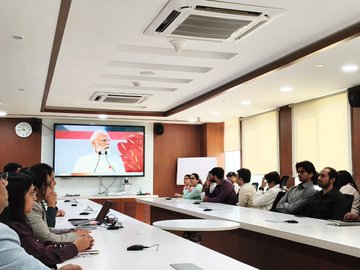
The debate acquired a dramatic public dimension when Prime Minister Narendra Modi addressed thousands of chartered accountants at ICAI’s Foundation Day. Blending praise with unmistakable warning, he reminded the profession that a chartered accountant’s signature carries enormous trust — often more decisive than that of ministers or bureaucrats.
The applause gave way to uneasy silence when he pointedly referred to the profession’s thin disciplinary record despite a growing number of corporate scandals, urging swift and visible accountability. Coming just as the government was moving to operationalise NFRA, the remarks were widely read as both a caution and a catalyst — signalling that the era of unquestioned professional self-regulation was drawing to a close.
The Birth of NFRA
Despite ICAI’s objections, the Companies Act, 2013 introduced Section 132 providing for the establishment of NFRA. What began as a proposal to expand the National Advisory Committee on Accounting Standards evolved, through Parliamentary Standing Committee deliberations, into a fully statutory independent regulator.
Once NFRA was formally constituted in 2018, the theoretical debate transformed into a complex institutional dynamic. ICAI retained authority over professional education and discipline for most members. NFRA assumed jurisdiction over audits of large public interest entities. An inevitable overlap — and an undercurrent of institutional rivalry — followed.
The Delhi High Court Intervention
The regulatory conflict reached the judiciary when several audit firms challenged NFRA’s disciplinary actions. In a landmark 2025 judgment, the Delhi High Court upheld the constitutional validity of Section 132 and NFRA’s establishment. However, it raised serious concerns about NFRA’s procedural architecture — specifically, the failure to adequately separate investigative functions from adjudicatory powers. Natural justice, the court held, requires a clear institutional distinction between investigation, prosecution, and adjudication.
The Supreme Court, while entertaining NFRA’s appeal, declined to stay the High Court judgment, permitted continuation of proceedings, but restrained the passing or enforcement of final orders. Three powerful propositions emerged: NFRA survives; its processes are under scrutiny; and enforcement is partially frozen. This created a regulatory tension zone that prolongs legal and institutional uncertainty for the profession.
From Turf War to Tactical Truce
What once appeared to be a simmering institutional standoff has begun softening into cautious, pragmatic engagement. This shift has not come through formal announcements but through subtle yet significant interactions signalling that coexistence is no longer optional — it is inevitable.
NFRA has taken up ICAI proposals on evolving accounting standards — a tacit acknowledgment that ICAI’s technical expertise remains indispensable even as NFRA retains statutory authority. Reports in early 2026 pointed to active discussions between senior leadership of both institutions on structured coordination mechanisms — including periodic interface meetings, clearer domain delineation, and protocols for sharing inspection findings and disciplinary intelligence.
In standard-setting, a de facto collaborative model has emerged: ICAI develops and refines technical standards; NFRA evaluates, modifies, and recommends them for notification. Discussions have also explored ways to avoid overlapping scrutiny of the same audit engagements. The tone has measurably changed — where earlier communications carried institutional defensiveness, recent interactions reflect measured professional engagement.
This détente is shaped as much by necessity as goodwill. The Delhi High Court judgment and Supreme Court scrutiny have underscored the imperative of procedural clarity, institutional coordination, and avoidance of regulatory overreach. Both institutions now operate under a judicial spotlight that demands not just authority, but coherence.
A Quiet Court Order Just Shook India’s Audit and NFRA Regime
Regulatory Architecture at a Crossroads
India’s audit regulatory architecture stands at a crossroads. Four priorities are clear. First, NFRA must refine its procedural framework to ensure genuine separation between investigative and adjudicatory functions. Second, a formal coordination mechanism between ICAI and NFRA must be established to prevent duplication and regulatory conflict.
Third, jurisdictional boundaries must be clearly defined — NFRA focusing on public interest entities, ICAI regulating the broader profession. Fourth, both institutions must prioritise transparency and public communication to rebuild trust in the audit profession.
Globally, the direction is clear. The PCAOB in the United States and the FRC in the United Kingdom demonstrate that independent oversight and professional self-regulation are not mutually exclusive. India’s hybrid model — still in formation — can draw on both traditions.
The ICAI position paper was a powerful articulation of professional self-regulation. It has since become largely archival. NFRA’s arrival has changed the game — auditors now know that lapses can trigger swift scrutiny.
But overlapping mandates, legal grey zones, and uneven enforcement have left audit firms navigating a fog of uncertainty. At a time when India is positioning itself as a stable, investor-friendly destination, such ambiguity risks diluting confidence rather than strengthening it.
Co-authoring India’s Audit Future
The future of audit regulation in India lies not in choosing between ICAI and NFRA — but in designing a system where professional expertise and independent oversight operate in constructive partnership. There are positive indications pointing in that direction. The thaw has begun. The co-authoring of India’s audit future — carefully, sometimes uneasily — is already underway.
(This is an opinion piece. Views expressed are author’s own.)
NFRA Enforcement Crisis: Why Audit Watchdog Is a Paper Tiger
Follow The Raisina Hills on WhatsApp, Instagram, YouTube, Facebook, and LinkedIn




