


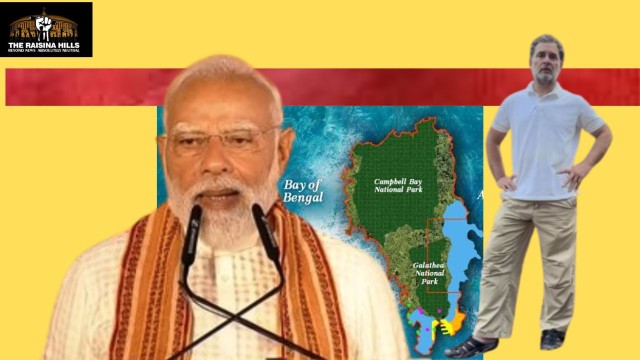
The Great Nicobar debate is ultimately a test case for India’s entire development philosophy — a question of whether growth and ecological sustainability can coexist, or whether one must inevitably be sacrificed for the other.
By TRH Op-Ed Desk
New Delhi, May 5, 2026 — India’s ambitious Great Nicobar Island development project has ignited one of the most fiercely contested policy debates of recent years — a clash between national security imperatives and ecological preservation that cuts to the heart of how Asia’s emerging superpower defines its future.
The project, conceived under a NITI Aayog blueprint, envisions a deep-sea transshipment port, a power plant, a greenfield township, and major infrastructure across the island’s southern tip. Proponents frame it as a generational geopolitical opportunity. Critics warn it could be an irreversible environmental catastrophe.
“The location of Great Nicobar is extremely significant — it sits near the Malacca Strait, through which a major portion of global maritime trade passes,” said Manish Anand, geopolitics analyst and host of the Raisina Hills YouTube channel. “If this project is completed, it could give India enormous leverage in the Indo-Pacific,” he added.
Anand drew a direct parallel to the Strait of Hormuz, noting how chokepoints can become instruments of global diplomacy. He argued that approximately 30 percent of China’s maritime movement of goods — particularly oil and gas — passes through the Malacca Strait, making Great Nicobar’s proximity to that corridor strategically vital for any nation seeking to monitor or influence Indo-Pacific dynamics.
The strategic case rests on several pillars. Supporters of the project argue that China’s string-of-pearls strategy — a network of ports and investments stretching from Vietnam to Pakistan to the Gulf and Africa — represents a deliberate encirclement of India. Great Nicobar, they contend, offers India a rare opportunity to establish a comparable forward presence. The island’s deep waters, unlike the shallower ports along India’s western coastline, can accommodate large naval vessels and heavy cargo ships, making it an ideal maritime hub.
Anand also highlighted a more pointed concern: in 2016, a Chinese diplomat reportedly suggested that Andaman and Nicobar Islands could become disputed territory in the future. “If India strengthens its infrastructure there today,” Anand noted, “it preempts any such challenge before it can gain traction.”
The Quad partnership further enters the calculus. With India, Japan, Australia, and the United States committed to free maritime movement in the Indo-Pacific, a fully operational Great Nicobar base could significantly reinforce that collective posture.
Yet the environmental stakes are equally stark. Great Nicobar is a UNESCO-recognised biosphere reserve and a biodiversity hotspot. The project is expected to require the felling of lakhs of trees across primary tropical rainforest. The island is home to rare species, including the critically endangered leatherback sea turtle — one of the largest reptiles on earth — alongside numerous endemic bird species. Scientists warn that damage to the ecosystem may be genuinely irreversible.
“The damage you cause here cannot be undone,” Anand warned, adding: “No amount of compensation in the future will restore what is lost.”
The human dimension is equally complex. The Shompen, one of India’s most isolated indigenous communities, have inhabited Great Nicobar for centuries, maintaining a way of life largely untouched by modernity. Activists fear the project will displace them and erode their cultural identity. The government has maintained that tribal communities will be protected, but environmentalists remain skeptical.
Anand drew a sobering comparison to the annual disasters in Uttarakhand and Himachal Pradesh, arguing they stand as evidence that development-driven ecological damage reliably rebounds on the very people it claims to serve.
He also questioned the framing of China as a readily containable rival at sea. “China is at least five times more powerful than India in naval terms. Disrupting Chinese shipping would not be easy for any country,” Anand said. “We need a fair balance — protect the ecology, minimise development, manage the strategic dimension, but do not destroy what cannot be rebuilt,” he added.
The Great Nicobar debate, Anand concluded, is ultimately a test case for India’s entire development philosophy — a question of whether growth and ecological sustainability can coexist, or whether one must inevitably be sacrificed for the other.
(Manish Anand hosts the Raisina Hills channel on YouTube, focusing on geopolitics and national security analysis.)
Follow The Raisina Hills on WhatsApp, Instagram, YouTube, Facebook, and LinkedIn




