


By P. SESH KUMAR
Sycophancy isn’t just a corporate problem. In government, it can distort policy, silence dissent and weaken institutions. Here’s why leaders need honest critics, not echo chambers.
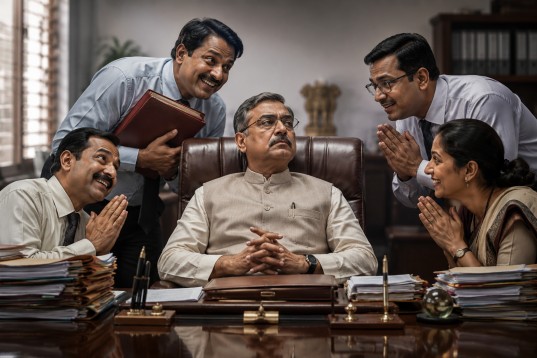
New Delhi, July 6, 2026 — The recent tongue-in-cheek conversation between industrialists Harsh Goenka and Gaurav Dalmia on the “Corporate Chamcha” in the Economic Times brilliantly lampoons a familiar character in Indian boardrooms — the consummate flatterer whose primary competence lies not in strategy, innovation or execution but in the sophisticated craft of agreeing with the boss. Humorous as the piece is, its satire extends far beyond the corporate sector. If anything, the phenomenon assumes even greater significance within government departments, public sector undertakings, autonomous institutions and the higher civil services, where hierarchy is formal, transfers frequent, promotions selective and dissent often carries invisible costs. Here, sycophancy is not merely a personality trait; it can become an institutional ecosystem. This essay critically examines the anatomy of the “government chamcha,” the incentives that produce him, the subtle damage he inflicts upon governance, public finance and administrative decision-making, and why every effective leader requires not a chorus of applause but an honest contrarian willing to say, respectfully, “Sir, there may be another way.”
Every bureaucracy produces files. Every file produces notes. Every note, somewhere along its journey, produces a chamcha.
Unlike the comic caricature of the office sycophant, the government chamcha is a far more sophisticated species. He rarely praises openly. His genius lies in calibrated admiration. He has mastered the bureaucratic equivalent of artificial intelligence long before algorithms became fashionable. He instinctively predicts the superior’s opinion before the superior himself has fully formed it. If the boss prefers speed, he becomes an evangelist of “time-bound disposal.” If caution is fashionable, he discovers constitutional prudence. If transparency is the day’s slogan, he quotes governance manuals. If secrecy suddenly becomes desirable, national interest is promptly invoked.
He possesses perhaps the most refined survival instinct in the Indian administrative ecosystem.
Unlike corporate executives, civil servants and public-sector managers seldom operate in competitive markets where profits quickly expose incompetence. Government decisions often reveal their consequences years later. This delayed accountability creates fertile soil for sycophancy. When outcomes are distant and responsibility diffuse, pleasing today’s boss becomes a far safer investment than serving tomorrow’s public interest.
The Indian administrative system unintentionally rewards this behaviour. Annual Performance Appraisal Reports, postings, deputations, foreign training programmes, prestigious committees, vigilance clearances and post-retirement appointments frequently remain substantially influenced by immediate superiors. Although formal safeguards exist, every officer understands that reputation often travels faster than documented performance.
Consequently, many discover an uncomfortable truth: disagreeing intelligently may demonstrate integrity, but agreeing enthusiastically frequently advances careers.
The tragedy begins when flattery masquerades as consensus.
Minus Marks, Zero Percentile, Full Seats: Is India Sacrificing Merit to Fill Classrooms?
Every important policy requires competing viewpoints. Sound public administration depends upon structured disagreement. Finance departments question spending ministries. Law departments examine legality. Technical experts identify operational risks. Audit highlights systemic weaknesses. Independent regulators introduce caution. Cabinet procedures deliberately seek inter-ministerial consultation precisely because wisdom rarely resides in one room.
The chamcha quietly dismantles this architecture. He assures the minister that “everyone agrees.” He informs the chairman that “there are no major concerns.” He edits minutes to soften objections. He discourages alternative opinions by branding them “negative.”
He selectively circulates favourable data while inconvenient statistics mysteriously remain buried somewhere between Annexure VII and Appendix XII. Soon the boss begins inhabiting an echo chamber. Psychologists call this confirmation bias.
Administrators call it smooth functioning. Historians later call it policy failure. Perhaps no institution illustrates this danger better than Government departments or even public sector enterprises.
A capable Secretary to Government or for that matter, a Chairman-cum-Managing Director, may inherit technically competent engineers, managers, economists and marketing professionals. Yet gradually, meetings begin acquiring remarkable uniformity. Every proposal is “visionary.” Every restructuring is “historic.” Every presentation concludes with colourful arrows pointing upward.
Targets become achievements before work even begins. PowerPoint replaces performance. Dashboards replace diagnosis. The boss, surrounded by applause, slowly loses access to reality. Ironically, nobody intends deception. Each participant merely suppresses one uncomfortable fact.
Collectively, those omissions become institutional blindness. The consequences can be extraordinarily expensive. Infrastructure projects experience cost overruns because early warnings were never voiced forcefully.
Procurement decisions proceed despite obvious commercial risks because questioning enthusiasm appears disloyal. Financial projections become progressively optimistic.
Completion dates remain permanently “next quarter.” Meanwhile, consultants produce increasingly elegant reports explaining why reality refuses to cooperate.
The government chamcha performs another invaluable-if dangerous-service. He protects the boss from criticism. At first glance, this appears compassionate.
In practice, it is deeply corrosive. Every organisation requires unpleasant information. Good leaders depend upon timely bad news.
Yet bad news has no natural constituency. Nobody enjoys carrying unpleasant facts into the corner office. The chamcha therefore becomes a sophisticated information filter.
Complaints are “isolated incidents.” Audit observations are “routine.” Media criticism is “politically motivated.” Parliamentary questions are “handled.” Citizen grievances are “exceptions.” Soon the boss sincerely believes everything is progressing magnificently.
Reality, unfortunately, remains unimpressed by optimism. Public administration offers countless illustrations of this phenomenon. Financial irregularities frequently continue for years because junior officers hesitate to question entrenched practices.
Projects acquire repeated extensions because everyone fears being labelled obstructive. Revenue leakages persist because exposing them embarrasses senior management. Recruitment scandals flourish because uncomfortable questions remain politely unasked.
When disasters finally erupt, inquiry commissions often discover that warning signals existed all along. The problem was never absence of information. The problem was absence of courage. One fascinating difference separates corporate and government chamchas.
Corporate flatterers generally pursue bonuses, promotions and stock options. Government chamchas pursue influence. Influence over transfers. Influence over postings. Influence over confidential reports. Influence over appointments. Influence over access.
They become unofficial interpreters of the boss’s mind. Visitors soon learn an unwritten rule. Meeting the boss is useful. Meeting the chamcha first is essential.
Eventually, the intermediary becomes more powerful than formal hierarchy itself. The greatest irony is that many exceptionally intelligent officers gradually become prisoners of this ecosystem. They begin careers full of curiosity. They ask difficult questions. They analyse evidence. They challenge assumptions. Then reality intervenes.
One inconvenient posting. One adverse appraisal. One missed promotion. One transfer to administrative Siberia. Gradually intellectual independence yields to administrative prudence. They stop asking whether an idea is correct. Instead, they ask whether it is convenient.
Institutional excellence quietly departs. Yet blaming only the chamcha would be intellectually dishonest. Every chamcha requires a willing audience.
Sycophancy flourishes only where leadership mistakes agreement for loyalty. The finest administrators in India’s history cultivated precisely the opposite culture. They welcomed dissent. They encouraged younger officers to disagree. They insisted that finance, law and technical experts record independent opinions.
Many legendary civil servants were remembered not because everyone agreed with them, but because everyone felt free to disagree without fear. That is genuine institutional confidence.
The relationship between audit and chamchagiri deserves special mention. Internal audit, vigilance, finance and external audit often represent the last organised resistance against institutional groupthink. An honest audit observation is, by definition, inconvenient.
It questions assumptions. It demands evidence. It introduces alternative narratives. Not surprisingly, sycophantic ecosystems frequently view auditors with suspicion.
The auditor becomes “negative.” The finance officer becomes “obstructionist.” The vigilance officer becomes “overenthusiastic.”
Yet history repeatedly demonstrates that today’s uncomfortable audit paragraph often becomes tomorrow’s accepted administrative reform.
The most successful leaders therefore recognise a profound truth. A flattering subordinate protects your ego. A questioning subordinate protects your legacy.
There is, however, another dimension often overlooked. Not every apparent chamcha is dishonest. Some genuinely admire exceptional leaders. Respect and loyalty are indispensable organisational virtues.
The distinction lies elsewhere.
Loyalty tells the boss what he needs to hear. Sycophancy tells him only what he wishes to hear. One strengthens leadership. The other anesthetises it.
Perhaps the most dangerous sentence in government is not “This cannot be done.” It is “Excellent idea, Sir.”
Those three words, uttered too frequently and too uncritically, have probably cost governments far more than corruption itself.
Policies have failed. Projects have collapsed. Institutions have weakened. Public money has evaporated.
Not because intelligent people were absent, but because intelligent people stopped speaking honestly.
The true measure of administrative maturity, therefore, is not the number of people praising the leader after every meeting.
It is whether someone around the table feels sufficiently secure to say, “Sir, may I respectfully offer a different perspective?”
For governments, public sector undertakings and every public institution entrusted with taxpayers’ money, that single sentence may be worth more than a thousand standing ovations.
In the final analysis, every leader eventually chooses between two mirrors. One reflects admiration; the other reflects reality. The first is polished daily by chamchas. The second is held up by honest colleagues, independent finance officers, vigilant auditors and courageous subordinates. The first flatters. The second saves institutions. Wise leaders know which mirror deserves pride of place.
(This is an opinion piece. Views expressed are the author’s own.)
India’s BoP Reality Check: Services Shine as Trade Deficit Widens
Follow The Raisina Hills on WhatsApp, Instagram, YouTube, Facebook, and LinkedIn




