


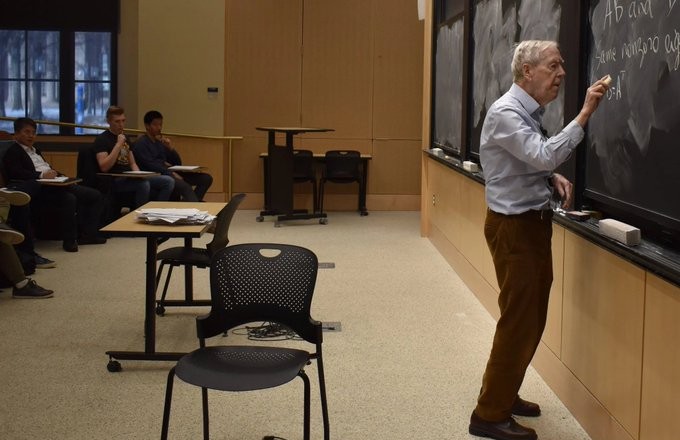
From a chalkboard in Cambridge to millions of screens worldwide, Strang quietly became the most influential math teacher of the AI age
By TRH Features Desk
New Delhi, April 26, 2026 — When Gilbert Strang delivered his final lecture at the Massachusetts Institute of Technology in 2023, it marked the end of an extraordinary teaching journey spanning over six decades. But the packed auditorium in Cambridge was only a fraction of his true classroom. Across the world, thousands more tuned in online—many of whom had never set foot on MIT’s campus, yet considered Strang their teacher.
Strang joined MIT’s mathematics faculty in 1962 and went on to teach the same course—18.06 Linear Algebra—for more than 60 years. “In an era where academic careers are often defined by research papers and citations, Strang built his legacy in the classroom, returning year after year to the fundamentals of matrices, vectors, and systems of equations,” wrote Ihtesham Ali, an educator, in an article on X.
The OpenCourseWare Revolution
His global impact accelerated in 2002 when MIT launched MIT OpenCourseWare, a bold initiative to make course materials freely available online. “At a time when many academics feared this would dilute the value of classroom teaching, Strang took the opposite view. He embraced the idea fully, recording his lectures and sharing them with the world,” added Ali.
The result was transformative. Students from India to Brazil, China to Nigeria began learning linear algebra not from local classrooms, but directly from Strang’s lectures—often via YouTube playlists that would go on to amass millions of views.
Rethinking How Math Is Taught
Strang’s genius lay not just in accessibility, but in pedagogy. For decades, linear algebra had been taught through heavy abstraction—vector spaces, proofs, and axioms that left many students overwhelmed.
Strang flipped that model, Ali stressed.
He began with matrix multiplication—something tangible, computable, and visual. “From there, he guided students toward deeper concepts like eigenvectors and orthogonality, ensuring intuition came before abstraction. His philosophy was simple: if you cannot explain an idea using a concrete example, you do not yet understand it,” added Ali.
This approach resonated deeply, particularly in the age of artificial intelligence, where linear algebra forms the backbone of machine learning systems.
Equally striking was Strang’s teaching style. He treated first-year students with the same respect as academic peers—avoiding dismissive phrases like “obviously” and frequently pausing to check if his audience was following, Ali stated.
“For over 60 years, he stood at the chalkboard with humility, patience, and a belief that every student belonged in the room,” wrote Ali.
The Quiet Architect of the AI Era
Today, countless engineers, data scientists, and programmers credit their understanding of AI fundamentals to Strang’s course. Universities themselves began recommending his lectures, acknowledging that his clarity was hard to match.
“His final lecture in May 2023 ended not with grand statements, but with quiet gratitude. In a brief note, he described teaching as ‘a wonderful life’ and expressed hope that the movement to teach mathematics well would continue,” Ali added.
In a world often driven by visibility and acclaim, Strang’s legacy stands apart—millions taught, knowledge freely shared, and a profound influence on the mathematical foundations of the AI revolution.
Follow The Raisina Hills on WhatsApp, Instagram, YouTube, Facebook, and LinkedIn




