


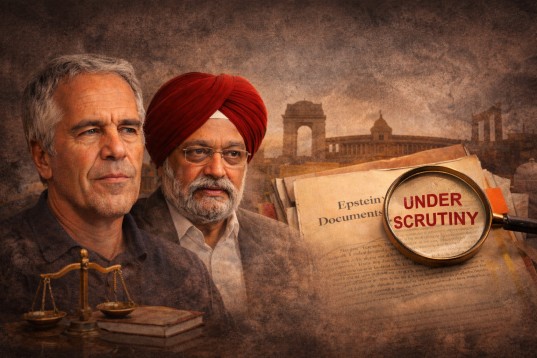
As Epstein-related disclosures trigger scrutiny abroad, journalist Manish Anand urges transparent clarification and institutional review in India
By TRH Op-Ed Desk
New Delhi, February 9, 2026 — Recent disclosures linked to the Jeffrey Epstein case have reignited global debate on transparency and accountability in public life, prompting scrutiny and institutional responses in several countries.
In India, journalist Manish Anand has argued that while no conclusions should be drawn without due process, the emerging material underscores the need for clarity, disclosure and democratic examination.
Speaking on The Raisina Hills YouTube channel, Anand noted that in the United Kingdom and parts of Europe, political systems have responded to Epstein-related revelations with official statements, internal reviews and, in some cases, political consequences. “There, the emphasis has been on fixing accountability gaps, not merely issuing apologies,” Anand observed.
He contrasted this with the Indian context, where references to Indian officials in publicly released documents have generated discussion but limited institutional response so far. Anand emphasised that the appearance of names or communications in released material does not by itself establish wrongdoing, but warrants transparent clarification.
“What is required is not presumption, but explanation,” Anand said, adding that public confidence in governance depends on timely and credible answers.
Anand referred to email exchanges involving senior Indian officials that have entered the public domain, stressing that these disclosures should be viewed carefully and in context. “The issue is not accusation,” he said, “but whether relationships, communications or facilitation—if any—were strictly official, fully disclosed, and consistent with national interest.”
He also pointed to the broader international concern that Epstein’s network may have posed risks beyond criminal wrongdoing, including potential vulnerabilities in governance systems. Anand underlined that such discussions remain speculative and should be examined, if at all, only through appropriate institutional mechanisms.
“In democracies, questions of this nature are best addressed through Parliament, committees and official review—not through conjecture,” he said.
Anand suggested that parliamentary bodies such as the Standing Committee on External Affairs are constitutionally empowered to seek clarification and examine matters of public importance, should they deem it necessary. “That process protects both national interest and individual reputations,” he added.
Noting that several Epstein-related files remain unreleased or partially redacted, Anand cautioned against complacency. “More information may yet emerge. Preparing institutions to respond transparently is wiser than reacting later under pressure.”
He concluded by arguing that democratic accountability does not imply guilt, but responsibility. “Silence is not neutrality,” Anand said. “Clear communication, timely clarification and institutional review strengthen democracy rather than weaken it.”
(This is an opinion piece. Views expressed are those of Manish Anand.)
Epstein Files: Can Keir Starmer Survive the Mandelson Scandal
Follow The Raisina Hills on WhatsApp, Instagram, YouTube, Facebook, and LinkedIn




