


By AMIT KUMAR
Cockroach Janata Party: Viral Meme Movement or Political Warning Sign? Why Millions of Young Indians Are Joining the Satire Revolt
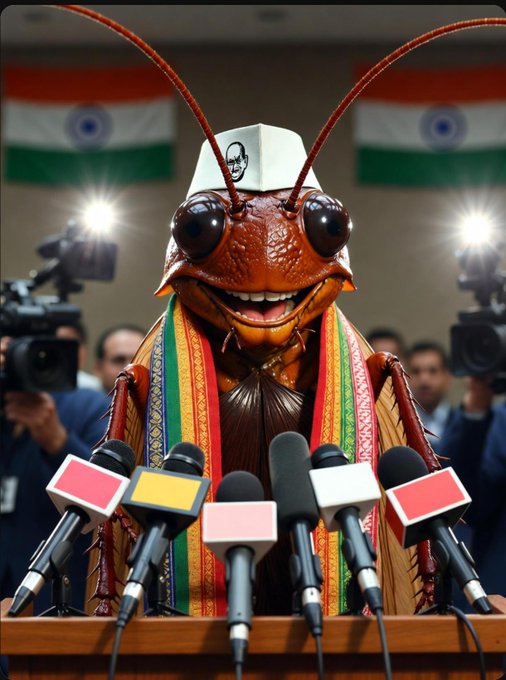
New Delhi, May 20, 2026 — A social media joke becoming a movement is not new. But a satirical formation calling itself the “Cockroach Janata Party” attracting more than three million followers within days has triggered a larger question: is this merely internet humour, or a political symptom of something deeper brewing among India’s youth?
The emergence of the platform reportedly followed remarks attributed to Chief Justice of India Surya Kant, where unemployed and system-critical youth with “fake degrees” were allegedly compared to “cockroaches.” Whether intended or interpreted that way, the phrase appears to have touched a nerve.
The response was swift. Social media user Abhijeet Dipke launched the satirical front, and Gen-Z users appeared to rally around it almost instantly. Yet the speed of the rise may be less important than why it happened.
More Than a Meme?
The “Cockroach Janata Party” began as satire. But satire often succeeds when it captures a sentiment already present in society. India’s younger population has spent the last several years navigating repeated competitive examination controversies, paper leak allegations, intense job competition, slowing formal employment growth, and rising concerns around educational quality and employability. Alongside this has come growing distrust in institutions among sections of digitally connected youth.
What appears striking in this episode is that millions reportedly followed a platform before any detailed manifesto, organisational structure or electoral roadmap existed.
That suggests people may not have been joining a political programme as much as joining an emotional expression.
The movement’s first official statement reflects this mood. It speaks less about ideology and more about governance metrics: jobs, entrepreneurship, inflation, education quality, transparency, accountability, public audits and policy-based politics.
Its language repeatedly returns to merit, opportunity, institutions and economic issues. This is notable because it departs from the identity-heavy political discourse that often dominates television debates.
India’s Governance Crisis: Leaks, Blackouts and Accountability
A Vacuum in Representation?
The larger issue raised by journalist Priyanshi Sharma on LinkedIn may be the more consequential one: are young Indians searching for representation beyond existing political structures?
Many young voters increasingly consume politics through social media rather than traditional party machinery. They are digitally native, meme fluent, and often sceptical of legacy institutions.
At the same time, frustration exists across multiple fronts: Employment anxieties; Competitive exam controversies; Rising costs and economic pressure; Distrust of mainstream media among some sections; and Disappointment with both ruling and opposition narratives.
The “Cockroach” label may have worked because it inverted insult into identity — a political technique seen globally where groups reclaim pejorative terms as symbols of resistance.
But Is It a Political Movement Yet?
Not necessarily. The movement still lacks organisational clarity, leadership depth, policy detail and offline mobilisation. Its founder’s previous association with the Aam Aadmi Party has already prompted questions from critics over political neutrality. The group has publicly denied acting as any party’s “B-team” and emphasised independence.
For now, it remains closer to a digital phenomenon than an institutional political force.
History is filled with viral movements that disappeared as quickly as they emerged. But history also shows that youth-led symbolic protests can become larger political currents when underlying grievances remain unresolved.
The Real Story Is the Mood, Not the Mascot
The important question may not be whether the “Cockroach Janata Party” survives. The question is why millions found it relatable.
If a satirical movement with minimal structure can gather such rapid support, it suggests many young Indians may be looking for something absent from mainstream discourse: a politics centred on jobs, merit, opportunity and accountability.
Whether this turns into organised politics or fades into internet history, it has already delivered a message. The mascot may be satire. The sentiment underneath appears more serious.

Follow The Raisina Hills on WhatsApp, Instagram, YouTube, Facebook, and LinkedIn




