


By KUMAR VIKRAM
As mainstream TV reporters face public hostility at the CJP protest, independent journalists and digital creators are emerging as the primary narrators of the movement, raising questions about whether India’s media landscape has entered a new era.
New Delhi, July 22, 2026 — Every mass movement rewrites politics. Occasionally, it also rewrites journalism.
The ongoing Cockroach Janata Party (CJP) protest may ultimately be remembered not only for its confrontation with the Narendra Modi government over examination irregularities and youth unemployment, but also for exposing a dramatic shift in how Indians consume and trust news.
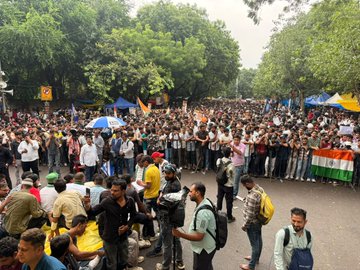
Television cameras are still present. The prime-time anchors continue to debate events from their studios. Yet on the streets surrounding Jantar Mantar and Parliament, the centre of gravity has unmistakably shifted.
Independent journalists, YouTube channels and digital-first content creators have become the principal storytellers of the protest.
The contrast has been striking. While several mainstream television reporters have faced heckling from protesters—reflecting a widening trust deficit—independent reporters have often been welcomed into crowds, livestreaming events, interviewing demonstrators and documenting police action in real time.
That changing perception was captured in a widely shared LinkedIn post by journalist Munazza Fatima Obaida, who described watching independent reporters cover the protests as a reminder of why she chose journalism in the first place.
She praised journalists working with limited resources while taking personal risks to document events as they unfolded.
More significantly, she wrote that her professional aspirations had changed. Instead of becoming a familiar face on mainstream television, she now wanted to earn public trust “through honest, fearless and responsible reporting, regardless of the platform.”
Her admiration for Peek TV and reporter Priyanshi Sharma is less important than what it symbolises: a generational shift in journalistic aspiration.
For decades, India’s journalism graduates largely measured success by one benchmark—landing a job at a major television network or national newspaper.
Today’s aspiring journalists increasingly appear to be measuring credibility differently.
The platform matters less than public trust.
Journalism Without Institutions
Technology has steadily eroded the monopoly of traditional media institutions over news gathering.
Affordable smartphones, high-speed mobile internet and livestreaming have dramatically lowered entry barriers.
One determined reporter with a phone, portable microphone and internet connection can now compete with organisations employing hundreds of journalists.
The CJP protest has demonstrated how that technological shift is changing news consumption.
Independent creators have produced continuous live coverage, lengthy interviews, unedited footage and minute-by-minute updates that audiences increasingly regard as more authentic than highly edited television packages.
Whether that perception is always justified is another matter.
The Trust Crisis
Mainstream media’s credibility problem did not emerge overnight.
Years of perceived proximity between sections of television media and political power have produced scepticism among many viewers.
The heckling witnessed during the CJP protest reflects that accumulated distrust.
Yet the rise of independent journalism should not automatically be romanticised.
Freedom from corporate ownership does not necessarily guarantee editorial independence.
Digital creators remain vulnerable to algorithmic incentives, audience capture, ideological echo chambers and financial pressures arising from subscriptions and crowdfunding.
In many cases, they also lack institutional safeguards such as legal departments, editorial review systems and fact-checking layers.
The challenge therefore is not mainstream versus independent media.
The real contest is between journalism that verifies and journalism that merely amplifies.
A New Public Sphere
The CJP movement may nevertheless represent an important media milestone.
Instead of waiting for television studios to define the narrative, citizens increasingly appear willing to curate their own information ecosystem by following multiple independent voices across platforms.
This decentralisation weakens traditional gatekeepers while strengthening direct relationships between reporters and audiences.
Trust becomes personal rather than institutional.
Reputation is built story by story rather than through the brand of a newsroom.
For journalism schools, this transformation carries profound implications. Students may no longer aspire simply to work for legacy organisations.
Increasingly, they may seek to build their own audiences, develop specialised expertise and establish credibility through transparent, on-ground reporting.
Independent journalism is unlikely to replace mainstream media altogether.
Large news organisations still possess reporting networks, legal resources, investigative capacity and institutional memory that independent creators often lack.
But the balance of influence is changing.
The CJP protest suggests that Indian journalism has entered a hybrid era in which credibility flows less from institutional authority and more from demonstrated public trust.
If that trend continues, the defining journalists of the next decade may not necessarily emerge from television studios.
They may emerge from crowded protest sites, livestreams, smartphones and audiences willing to reward those who consistently place facts above access and courage above convenience.
The future of Indian journalism may not belong exclusively to mainstream media or independent creators.
It may belong to whoever earns the public’s trust every single day.
(This is an opinion piece. Views expressed are the author’s own.)
Dharmendra Pradhan Strikes a Defiant Tone Amid CJP Student Protest
Follow The Raisina Hills on WhatsApp, Instagram, YouTube, Facebook, and LinkedIn




