


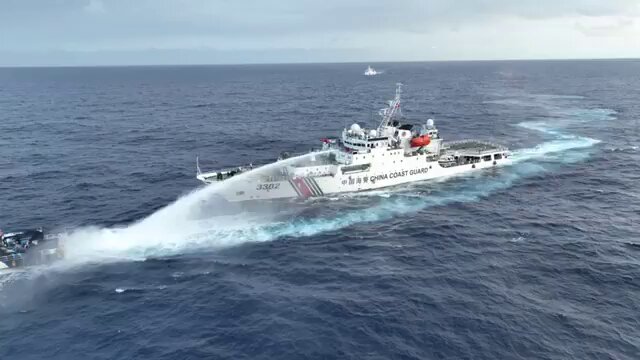
By TRH World Desk
Beijing says Manila’s move violates international law and infringes on China’s sovereignty over Huangyan Dao, as tensions rise weeks after a 14-nation coalition backed the 2016 South China Sea arbitration ruling.
New Delhi, July 31, 2026 — China has sharply rejected the Philippines’ decision to delimit what Manila describes as the territorial sea baselines around Huangyan Dao (Scarborough Shoal), calling the move “illegal, null and void” and warning that it would respond “resolutely” to any further actions it considers provocative.
In a strongly worded statement issued on Friday, China’s Ministry of Foreign Affairs said the Philippines had committed “a grave infringement upon China’s territorial sovereignty” and violated international law, including the United Nations Charter and the United Nations Convention on the Law of the Sea (UNCLOS).
“China firmly rejects and will never accept it,” the ministry said.
Beijing reiterated its long-standing position that Huangyan Dao is “China’s inherent territory” and asserted that it has “indisputable sovereignty” over the disputed shoal and its adjacent waters.
The statement also rejected the 2016 South China Sea arbitration award, which overwhelmingly favoured the Philippines, arguing that the arbitration process itself violated international law and bilateral agreements between Beijing and Manila.
According to China, the tribunal’s ruling has “no binding force,” and Beijing “neither accepts nor recognises” the award.
China Criticises Philippine Maritime Law
The Chinese Foreign Ministry also criticised the Philippines’ Maritime Zones Act, accusing Manila of using domestic legislation to reinforce the arbitration ruling.
Beijing said the law illegally includes Huangyan Dao and large parts of the Nansha Qundao (Spratly Islands) within Philippine maritime zones, insisting that such legislation cannot affect China’s territorial sovereignty or maritime rights.
The ministry accused the Philippines of repeatedly carrying out what it described as “provocations” around Huangyan Dao and of escalating tensions in the South China Sea.
“China urges the Philippines to earnestly respect China’s territorial sovereignty and maritime rights and interests, and refrain from any act of infringement or provocation,” the statement said, warning that China would “respond resolutely” if such actions continue.
Background: International Pressure on Beijing
The latest exchange comes against the backdrop of increasing international support for the 2016 Permanent Court of Arbitration ruling, which invalidated China’s expansive “nine-dash line” claims in the South China Sea.
Earlier this month, a 14-nation coalition issued a joint statement urging respect for the arbitration award and calling for adherence to international law and freedom of navigation in the South China Sea. The statement reflected growing concern among maritime powers over rising tensions and the need to preserve a rules-based order in one of the world’s busiest shipping corridors.
The Raisina Hills had earlier reported that the joint declaration marked one of the broadest multilateral endorsements of the 2016 ruling in recent years, underscoring increasing diplomatic pressure on Beijing over its maritime claims.
Strategic Significance
Scarborough Shoal, known as Huangyan Dao in China, has remained one of the most sensitive flashpoints in the South China Sea since Chinese vessels assumed effective control of the area in 2012 following a prolonged standoff with the Philippines.
The disputed waters are strategically important because they sit astride major international shipping lanes and are believed to contain rich fishing grounds and potential hydrocarbon reserves.
The latest diplomatic confrontation signals that legal, diplomatic and strategic competition between China and the Philippines is likely to intensify further despite recent efforts to stabilise bilateral ties.
South China Sea at 10: Why the Hague Ruling Still Haunts China
Follow The Raisina Hills on WhatsApp, Instagram, YouTube, Facebook, and LinkedIn




