


China as Global Peacemaker: Ceasefire, Mediations and the Limits of Beijing’s Leverage
By TRH World Desk
New Delhi, April 10, 2026 — In a span of a single week, China has orchestrated a ceasefire in the Middle East and brokered fragile peace talks between Afghanistan and Pakistan — burnishing its claim to the role it has long sought: the world’s peacemaker of last resort.
The flurry of diplomatic activity marks what may be Beijing’s most consequential multilateral engagement since the founding of the People’s Republic. But even as world leaders acknowledge China’s role, analysts are questioning whether Beijing possesses the durable leverage its ambitions demand.
The Iran Ceasefire: China Steps In at the Eleventh Hour
When the guns fell silent between Iran and the United States-Israeli coalition late Tuesday, few expected Beijing to be among the architects of the pause. Yet in Washington, US President Donald Trump confirmed China’s involvement when asked directly by AFP whether Beijing had helped persuade Tehran to negotiate. “I hear yes. Yes, they were,” Trump said.
Behind the scenes, Chinese Foreign Minister Wang Yi per reports had been working the phones relentlessly. Wang Yi made 26 phone calls with parties including Iran, Israel, Russia and the Gulf states, while China’s Special Envoy on the Middle East shuttled across the region in a mediation effort.
Pakistani Prime Minister Shehbaz Sharif’s outreach also led to a joint five-point initiative with Beijing, which included a ceasefire, early dialogue, civilian protection, restoration of shipping through the Strait of Hormuz, and a larger UN role.
Finnish geopolitics analyst Sari Arho Havrén, writing on X, summarised the prevailing view among observers: “Beijing apparently stepped in at the 11th hour and made the ceasefire with Iran happen.”
Yet Beijing’s role was not without its ambiguities. Chinese Foreign Minister Wang Yi condemned Israel’s attacks on Iran during a phone call with his Iranian counterpart, but stopped short of doing so in a parallel call with his Israeli counterpart on the same day. Chinese President Xi Jinping maintained a policy of offering to play a ‘constructive role’ in de-escalation without explicitly proposing to mediate, and his four-point proposal for de-escalation principles avoided direct condemnation of Israel.
Analysts at Chatham House noted that China’s reluctance to fully back Tehran stemmed in part from concerns about Iran’s military vulnerability, after Israel successfully struck nuclear sites and military infrastructure with minimal losses.
Urumqi: Brokering Peace Between Afghanistan and Pakistan
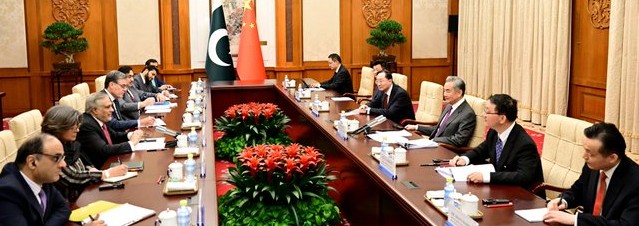
Simultaneously, in the far northwest of China, a quieter but equally significant diplomatic process was unfolding. Representatives from China, Afghanistan and Pakistan held week-long informal talks from April 1 to 7 in Urumqi, in China’s Xinjiang region.
Pakistan and Afghanistan agreed to avoid escalation in their armed conflict and pledged to resolve differences and return bilateral relations to normal as soon as possible.
The talks were notable for their breadth. The cross-departmental delegations included representatives from foreign affairs, defence and security ministries of all three countries, and the discussions were described as candid, pragmatic and conducted in a sound atmosphere.
The three sides agreed to discuss a comprehensive plan to resolve issues in Afghanistan-Pakistan relations and identified core and priority issues, with China emphasising that terrorism remains the central challenge affecting the bilateral relationship.
Both Kabul and Islamabad were effusive in their praise of Beijing’s role. The Afghan and Pakistani sides commended and thanked China for the mediation effort and thoughtful arrangement as the host country, expressing appreciation for what they described as China’s fair and just position.
The outcome — known as the “Urumqi process” — is tentative. But for a relationship that had descended into cross-border military exchanges killing hundreds, it represents a meaningful diplomatic opening.
China-Iran Military Pact — And What It Means for India-Pakistan
A Pattern: From Ukraine to the Middle East to South Asia
China’s latest mediations did not emerge from nowhere. They are part of a deliberate, years-long effort by Xi Jinping to position Beijing as an alternative to Western-led conflict resolution mechanisms.
In February 2023, Beijing released its 12-point position paper on the Ukraine crisis — widely described as a peace plan, though critics noted its limitations. The 12 points were considered too abstract to serve as a road map to end the war, with analysts suggesting the initiative was primarily a move in China’s informational and diplomatic rivalry with the United States rather than a genuine peace framework.
With that plan, China took a significant step toward centre stage in international politics, departing from its historical practice of avoiding risks and responsibilities on foreign policy questions not directly relevant to its national security. Critics argued it served Xi’s broader Global Security Initiative — a framework for a new world order with China at its centre.
The Saudi Arabia-Iran rapprochement brokered by Beijing in 2023 was widely seen as the inflection point: the moment China demonstrated it could translate economic relationships into tangible diplomatic outcomes.
The Question of Leverage
The central debate among analysts is not whether China is active — it clearly is — but whether its activism rests on genuine leverage or diplomatic theatre.
In the Middle East case, Beijing’s unique position stems from its energy dependence on the Gulf and its status as Iran’s largest trading partner and diplomatic protector. Those are real cards. Yet China’s risk-averse response to the Iran-Israel war — hedging rather than leading — may lead regional powers to conclude that its mediation style is limited by its unwillingness to take sides.
In the Afghanistan-Pakistan case, China’s leverage is structural: it shares borders with both nations, is the dominant economic actor in Pakistan through the China-Pakistan Economic Corridor (CPEC), and has cultivated formal ties with the Taliban government in Kabul that Western nations still refuse to recognise.
In Ukraine, China’s leverage has proven elusive. Despite its proximity to Moscow, Beijing has been unable — or unwilling — to press Russia towards a negotiated settlement, leading European partners to question the sincerity of its peace rhetoric.
What Beijing Wants
China’s peacemaker posture serves multiple strategic interests simultaneously. It projects the image of a responsible great power to the Global South. It undercuts the narrative that Washington is the indispensable nation. It builds goodwill in regions where Beijing has significant economic investments. And it allows Xi Jinping to demonstrate that China’s model — dialogue over confrontation, development over deterrence — offers an alternative to the Western security order.
Whether that model holds up under the weight of the world’s most intractable conflicts remains the defining question of China’s diplomatic ambitions.
For now, as the guns pause in the Gulf and diplomats depart Urumqi, Beijing can claim something few expected: that in a conflict-ridden world, it is the phone number others are dialling.
Follow The Raisina Hills on WhatsApp, Instagram, YouTube, Facebook, and LinkedIn




