


By TRH World Desk
The June 26 China-Bangladesh Joint Communiqué goes far beyond economics, laying the groundwork for deeper defence, diplomatic and connectivity cooperation that could reshape South Asia’s strategic balance and pose fresh challenges for India’s neighbourhood policy.
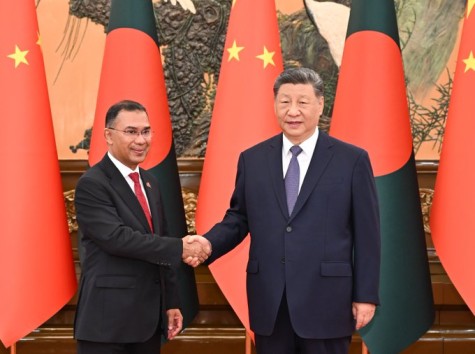
New Delhi, June 26, 2026 — The joint communiqué issued at the conclusion of Bangladeshi Prime Minister Tarique Rahman’s five-day visit to China is one of the most consequential foreign policy documents to emerge in South Asia this year. While couched in the familiar language of “shared development” and “mutual cooperation,” the text reveals a significant expansion of China’s strategic engagement with Bangladesh across diplomacy, defence, infrastructure, water resources and multilateral institutions.
For India, the document deserves careful scrutiny—not because it announces an alliance against New Delhi, but because it institutionalises China’s long-term presence in a country that shares more than 4,000 kilometres of border with India.
Strategic Dialogue Moves Beyond Economics
Perhaps the most striking element of the communiqué is the decision to establish a strategic dialogue between the foreign ministers of China and Bangladesh while simultaneously exploring a “2+2” dialogue mechanism on diplomacy and defence.
Such institutional mechanisms are typically reserved for countries seeking closer strategic coordination rather than merely expanding trade.
Unlike previous Bangladesh-China statements that focused primarily on infrastructure financing under the Belt and Road Initiative (BRI), this communiqué elevates political and security engagement to a new level.
For India, which already faces an increasingly assertive China along the Line of Actual Control, Beijing’s effort to build structured security consultations with Dhaka represents a notable geopolitical development.
Defence Cooperation Becomes Explicit
The communiqué goes beyond previous formulations by specifically committing both countries to deepen defence cooperation through exchanges, visits and training. Although Bangladesh has long purchased military equipment from China, this statement indicates an intention to institutionalise defence ties.
Combined with the proposed 2+2 mechanism, defence engagement now appears set to become a regular pillar of bilateral relations rather than remaining limited to arms sales.
India has traditionally viewed Bangladesh as one of its closest security partners, particularly under Sheikh Hasina’s government. The new language suggests Dhaka is seeking greater strategic diversification.
The Teesta River Enters China’s Strategic Calculus
One of the most sensitive provisions concerns the Teesta River Comprehensive Management and Restoration Project (TRCMRP). China has pledged support for feasibility studies, technical assistance and river management.
This is significant because Teesta water-sharing remains one of the most contentious unresolved issues between India and Bangladesh.
Should Beijing emerge as a principal development partner on the Teesta, China would gain influence in an issue historically considered part of India’s bilateral engagement with Dhaka.
It represents an expansion of Chinese involvement into South Asia’s water diplomacy.
Connectivity Without Naming India
The communiqué repeatedly mentions expanding regional connectivity and even exploring direct connectivity between China and Bangladesh. Although the document does not explicitly reference India, geography makes New Delhi impossible to ignore.
Direct transport corridors between western China and Bangladesh would inevitably require either Indian transit, routes through Myanmar, or maritime alternatives.
Each carries strategic implications.
Such connectivity proposals align with Beijing’s broader effort to integrate South Asia into its Belt and Road network.
Bangladesh Fully Reaffirms One-China Policy
Bangladesh leaves little ambiguity regarding Taiwan.
The communiqué states Dhaka supports China’s position that Taiwan is an inalienable part of China and opposes any form of Taiwanese independence.
While Bangladesh has long recognised Beijing diplomatically, the unusually strong language reflects growing political alignment with Chinese foreign policy priorities.
China, in return, reiterates support for Bangladesh’s sovereignty and development path.
BRICS, SCO and China’s Multilateral Vision
Another notable provision is China’s support for Bangladesh’s participation in BRICS and its application to become a partner of the Shanghai Cooperation Organisation (SCO).
This reflects Beijing’s broader effort to expand alternative multilateral institutions alongside the Western-led international order.
Bangladesh appears increasingly willing to align itself with these Chinese-backed platforms.
Trade, Industry and Manufacturing
Economically, China promises expanded cooperation in: Industrial supply chains; E-commerce; Green energy; Photovoltaics; Artificial intelligence and technology; Chattogram industrial zone; and Mongla Port expansion.
The communiqué also highlights China’s continuation of zero-tariff treatment on 100 percent tariff lines for Bangladeshi exports.
Together these initiatives could deepen Bangladesh’s dependence on Chinese capital, technology and manufacturing ecosystems.
Why India Should Be Concerned
India should avoid interpreting the communiqué as an anti-India alliance. Bangladesh continues to value close economic, cultural and security ties with New Delhi. However, the document demonstrates that Dhaka is consciously broadening its strategic options.
For nearly fifteen years, India enjoyed unprecedented political goodwill under Sheikh Hasina. Following Bangladesh’s political transition, China appears to be moving quickly to consolidate influence through institutional arrangements rather than isolated infrastructure projects.
The communiqué reflects Beijing’s patient strategy: embed itself across multiple sectors—defence, diplomacy, infrastructure, education, water management and multilateral governance—making its influence increasingly difficult to reverse.
Wider South Asia Implications
The immediate implications will depend on implementation. Many joint communiqués announce ambitious goals that take years to materialise.
Yet this document is notable because it creates mechanisms—strategic dialogue, defence consultations, connectivity planning and river management cooperation—that establish permanent channels of engagement.
For India, the challenge is not simply responding to China’s growing presence. It is rebuilding strategic confidence with Bangladesh through timely infrastructure delivery, resolution of outstanding bilateral issues such as the Teesta agreement, expanded trade integration and sustained political engagement.
South Asia’s geopolitical contest is increasingly being shaped not through military confrontation but through infrastructure, institutions and long-term partnerships.
The China-Bangladesh communiqué suggests Beijing understands that reality—and is acting accordingly.
Follow The Raisina Hills on WhatsApp, Instagram, YouTube, Facebook, and LinkedIn




