


By TRH World Desk
Video footage shows young Moroccans swimming, climbing, and tunneling into Spain’s North African enclave on Thursday, as local officials demand a national emergency declaration.
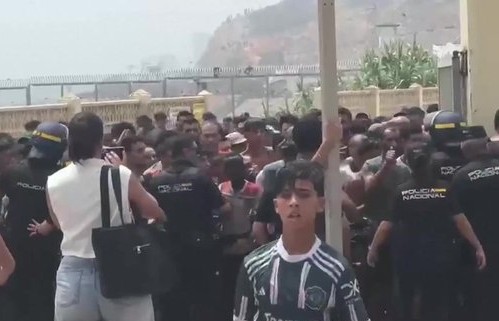
New Delhi, July 30, 2026 — Video circulating Thursday shows hundreds of migrants entering Ceuta, Spain’s autonomous city on Morocco’s northern coast, some wading and swimming across the Tarajal border point, others climbing or tunneling under the fence separating Castillejos, Morocco, from Spanish territory.
According to Spain’s state news agency EFE, thousands of young Moroccans converged on the frontier during Thursday morning in what appeared to be a coordinated push, arriving on foot, by motorbike, and by car from multiple points around the city.
One young man captured by EFE at the scene summed up the plan as he ran toward the barrier: “Vamos a la valla, no por el mar, a la frontera.” Mediaset’s Cuatro reported that the Guardia Civil deployed inflatable boats to pull swimmers from the water and prevent drownings, with children among those attempting the crossing, while some arrivals required medical treatment for injuries sustained at the fence.
Moroccan security forces initially attempted to hold the line at several access points, but withdrew as the crowds advanced, according to EFE’s on-the-ground reporting. Regional broadcaster El Ideal Gallego reported that dozens managed to reach the border wire through a gap dug beneath it, an opening most of the group had already used before a small contingent of Moroccan officers arrived to try to block it.
Thursday’s fence-jumping followed roughly ten days in which, according to Spain’s Interior Ministry as reported by El Correo Gallego, between 1,500 and 2,000 people had already entered Ceuta by swimming from Moroccan beaches — meaning Thursday’s land crossing added to, rather than replaced, an existing maritime surge. The exact size of Thursday’s crowd at the fence itself was not immediately confirmed by Spanish authorities, though multiple outlets described it as running into the thousands on the Moroccan side, with “hundreds” successfully crossing into Ceuta.
The scale of the crossing pushed Ceuta’s regional president, Juan Jesús Vivas, to formally request Madrid declare a national emergency and close the border outright, according to El Correo Gallego, which reported he asked the central government for an “energetic, decisive, and immediate” response with the backing of every party represented in the city’s assembly.
Prime Minister Pedro Sánchez personally called Vivas to try to calm the situation, the outlet reported, and Interior Minister Fernando Grande-Marlaska is expected to travel to Ceuta on Friday to assess it directly — though a formal national emergency declaration appears to have been ruled out for now.
Not everyone in Ceuta read the moment the same way. Vox’s spokesman in the city’s assembly, Juan Sergio Redondo, went further than Vivas, accusing the Kingdom of Morocco of mounting an “invasion” of Spanish territory and calling for the resignations of both Sánchez and Grande-Marlaska, according to Cuatro’s coverage of a video Redondo posted.
That framing is a political characterization from a single party, not a claim independently verified by Spanish authorities, who instead described the response from Rabat as cooperative: Spain’s Interior Ministry, per Infobae’s wire reporting sourced to EFE, publicly praised what it called the :ejemplar colaboración”— exemplary collaboration — between Spanish and Moroccan authorities on the migration file.
Spain-based reporting points to a specific trigger behind the timing of the maritime surge that preceded Thursday’s land crossing. According to El País, cited in wire coverage of the crisis, Spain’s Supreme Court issued a ruling in early July that bars the use of so-called “devoluciones en caliente” — the immediate, on-the-spot expulsion of migrants intercepted at the border without formal processing.
Spain’s Interior Ministry has accused people-smuggling networks of actively exploiting that ruling to encourage undocumented migrants, disproportionately young people, to attempt the crossing, betting that anyone who reaches Spanish soil is now harder to turn back immediately.
Thursday’s land rush also coincided with a Moroccan national holiday: EFE reported the timing lined up with Morocco’s Fiesta del Trono, marking the 27th anniversary of King Mohammed VI’s enthronement, though security officials told EFE at the scene they could not identify a specific reason for the mass gathering at the fence.
Spain and Morocco have agreed to strengthen coordination on returning those who entered Ceuta illegally, according to El Correo Gallego, with both governments committing to review and speed up removal procedures for the recent arrivals. Grande-Marlaska’s Friday visit is the next concrete marker to watch — both for what, if any, additional security measures Madrid announces, and for whether Vivas’s request for a national emergency declaration gains any further traction once the interior minister has assessed the situation on the ground.
Follow The Raisina Hills on WhatsApp, Instagram, YouTube, Facebook, and LinkedIn




