


By TRH News Desk
What happens if AI matches human creativity, intuition and reasoning? US academic John MacCormick argues that humanity may be entering a new “Darwin moment” — one that could fundamentally reshape how we understand ourselves.
Mumbai, May 31, 2026 — The rapid advance of artificial intelligence may push humanity toward a profound intellectual reckoning. This could be comparable to the one sparked by Charles Darwin’s theory of evolution. American computer scientist and author John MacCormick has made an insightful dissection of the sweeping unravelling of the AI in an article.
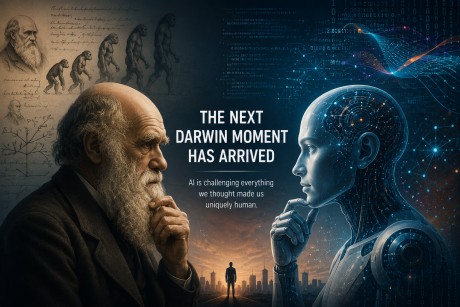
In the opinion essay titled “The Next Darwin Moment Has Arrived,” MacCormick argues that increasingly capable AI systems are challenging long-held assumptions about what makes human beings unique. The article was published in the Washington Post.
“Can computer programs emulate the entire range of human thought, including creativity and intuition?” MacCormick asks at the outset of the essay. While acknowledging that there are reasons to believe the answer may still be uncertain, he contends that recent developments in artificial intelligence make the question impossible to ignore.
MacCormick, a professor at Dickinson College and the author of Thinking AI: How Artificial Intelligence Emulates Human Understanding, notes that AI systems are improving at a remarkable pace. He points to advances across disciplines ranging from physics and chemistry to music composition and visual creativity as evidence that machines are increasingly performing tasks once thought to be uniquely human.
The essay draws a parallel with the intellectual shock produced by Darwinism in the nineteenth century. Darwin’s theory challenged the belief that humans occupied a fundamentally separate place in creation. According to MacCormick, artificial intelligence could trigger a similar shift by undermining the assumption that reasoning, creativity and intuition belong exclusively to the human mind.
In India, Karan Singh, an authoritative thinker, had last year asked at a function at the India International Centre: “Will the AI acquire consciousness.” The discourse around the AI is evolving, with some even seeking help of spiritual heads to decode some of the mysteries such as chat boxes gaining autonomy in functions.
“The uniqueness of the human mind is an old idea,” MacCormick wrote. He argued that many aspects of human cognition may ultimately be explainable as physical processes that can be replicated by advanced computational systems.
Yet MacCormick does not present the rise of AI solely as a threat. Instead, he suggests that humanity should prepare to redefine its sense of purpose in a world where machines may match or exceed human intellectual capabilities. “Society is best served by accepting this new reality and looking for ways to flourish within it,” he argued in the essay.
Human Intelligence vs Artificial Noise: The War of Algorithms
Follow The Raisina Hills on WhatsApp, Instagram, YouTube, Facebook, and LinkedIn




